
What Is RAG? How Retrieval-Augmented Generation Makes AI More Reliable
Updated on October 06, 20269 minutes read
Introduction: Why LLMs Sometimes Give Unreliable or Incomplete Answers
Large language models (LLMs) like GPT-style systems can write code, summarize documents, and answer questions on almost any topic. But ask one about your company's internal policy, last week's news, or a niche technical detail, and the cracks start to show.
This happens because an LLM only "knows" what it learned during training. It has no built-in connection to your private files, no awareness of events after its training cutoff, and no way to verify facts in real time. When it doesn't have the right information, it doesn't always say so. It sometimes generates a plausible-sounding but incorrect answer. This is commonly called a hallucination.
Retrieval-Augmented Generation, or RAG, was developed to address exactly this gap. Instead of relying solely on what the model memorized during training, RAG gives the model a way to look things up before it answers.
What Is Retrieval-Augmented Generation (RAG)?
Retrieval-Augmented Generation is a technique that combines two components: a retrieval system that searches a knowledge base for relevant information, and a generative model (the LLM) that uses that information to produce an answer.
In simple terms, RAG lets an LLM "read" relevant material before responding, rather than answering purely from memory. This is similar to how a person might search a document library or the web before writing a report, instead of relying only on what they remember.
The knowledge base behind a RAG system can be almost anything: a company's internal documentation, a product manual, a set of legal contracts, customer support tickets, or a curated collection of articles. The key idea is that the model's answer is grounded in real, retrievable content rather than generated from parametric memory alone.
RAG vs. Traditional LLM Prompting
To understand why RAG matters, it helps to compare it to how LLMs are typically used without it.
In traditional prompting, a user asks a question, and the model generates an answer directly from what it learned during training. This works well for general knowledge, reasoning tasks, and creative writing. It works poorly when the question depends on information the model never saw, such as private documents, recent events, or highly specific domain data.
| Aspect | Traditional Prompting | RAG |
|---|---|---|
| Knowledge source | Model's training data only | Training data + retrieved external content |
| Freshness | Fixed at training cutoff | Can reflect up-to-date information |
| Private/domain data | Not accessible | Can be included via a knowledge base |
| Risk of hallucination | Higher for unfamiliar topics | Reduced, since answers are grounded in retrieved text |
| Transparency | Hard to trace where an answer came from | Retrieved sources can be shown or cited |
RAG doesn't replace the LLM's reasoning ability. It supplements it with relevant, retrievable evidence.
The Basic RAG Pipeline: Question → Retrieval → Context → Generation
A RAG system generally follows four steps, regardless of the specific tools used to build it.
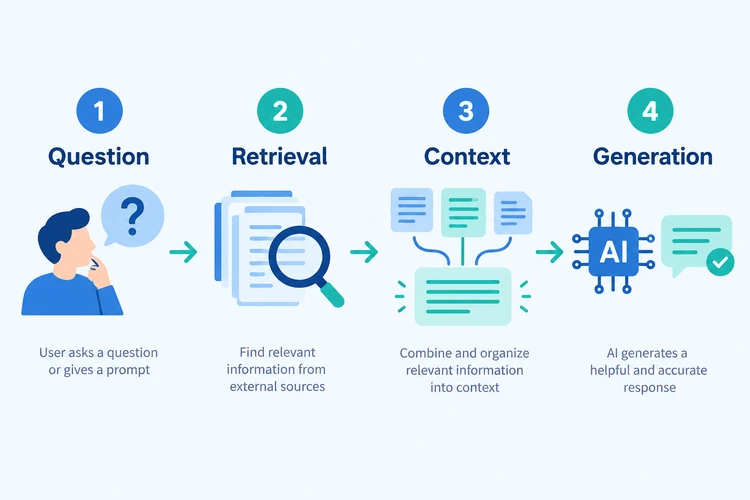
1. Question. The user submits a query, such as "What is our refund policy for annual subscriptions?"
2. Retrieval. The system searches a knowledge base for content relevant to that query. This usually involves converting the query into a numerical representation and comparing it against a pre-indexed collection of documents.
3. Context. The most relevant passages retrieved are assembled into a context block. This is inserted alongside the original question in the prompt sent to the LLM.
4. Generation. The LLM reads both the question and the retrieved context, then generates an answer grounded in that material, ideally citing or reflecting the source content rather than inventing an answer from scratch.
This pipeline can be extended with additional steps, such as re-ranking retrieved results by relevance or filtering out low-quality matches, but the core loop of retrieve-then-generate stays the same.
Why Retrieval Matters
The retrieval step is what separates RAG from simply pasting a document into a prompt. Most real-world knowledge bases are far too large to fit inside a single prompt, so the system needs a way to find the small subset of content that's actually relevant to a given question.
Good retrieval matters for a few practical reasons:
- Accuracy. If the retrieved content is irrelevant, the generated answer will be too. No amount of model quality can compensate for bad input.
- Efficiency. Sending only relevant passages, rather than an entire knowledge base, keeps prompts within the model's context limits and reduces cost.
- Trust. When retrieval works well, answers can be traced back to specific source documents, making the system's output easier to verify.
In short, a RAG system is only as good as its retrieval step. This is why much of the engineering effort in building RAG applications goes into designing how content is indexed and searched.
What Makes Retrieval Useful: Keyword, Semantic, and Contextual Relevance
Not all retrieval methods work the same way, and understanding the differences helps explain why RAG systems are more than just a search box attached to an LLM.
Keyword search matches exact words or phrases between the query and the documents. It's fast and predictable but struggles when the user's wording doesn't match the document's wording. For example, searching "cancel my plan" won't necessarily match a document titled "subscription termination."
Semantic search (often called vector search) addresses this by converting both the query and the documents into numerical vectors, mathematical representations that capture meaning rather than exact words. Documents and queries that are conceptually similar end up close together in this vector space, even if they use different phrasing. This is typically powered by a vector database, which stores these representations and allows fast similarity comparisons.
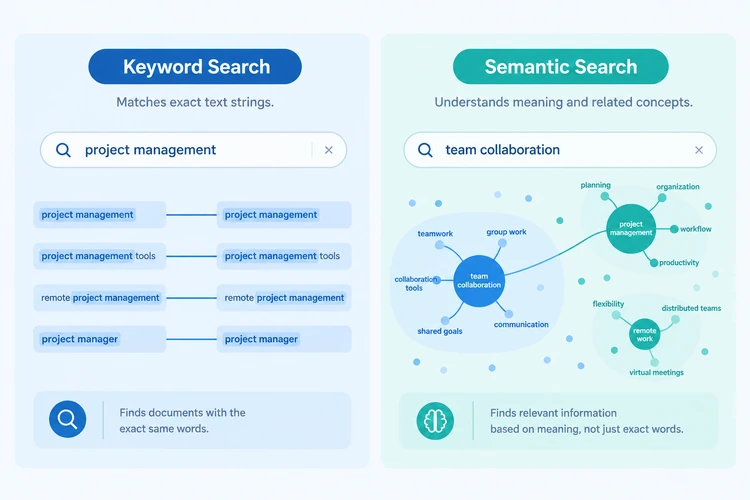
Contextual relevance goes a step further by considering surrounding information, such as conversation history, user role, or document metadata, to refine which results are actually useful, not just topically related. For example, a support query from an enterprise customer might need results filtered to enterprise-tier documentation rather than general help articles.
Most production RAG systems combine these approaches, using keyword matching for precision, semantic search for flexibility, and contextual filters for relevance, rather than relying on just one technique.
RAG vs. Fine-Tuning
RAG is often compared to fine-tuning, another common method for adapting an LLM to specific data. The two solve different problems, and understanding the distinction helps in choosing the right approach.
Fine-tuning involves further training a model on a specific dataset, adjusting its internal parameters so it "absorbs" new patterns, style, or knowledge. This is useful for teaching a model a particular tone, format, or specialized skill, but it's not well suited for keeping information current, since every update to the underlying data requires retraining.
RAG doesn't change the model itself. Instead, it changes what information the model has access to at the moment of answering. This makes it far easier to keep information up to date: updating a knowledge base is much simpler than retraining a model.
| Consideration | Fine-Tuning | RAG |
|---|---|---|
| What changes | Model's internal weights | External knowledge base |
| Best for | Style, tone, task-specific behavior | Fresh, factual, or private information |
| Update process | Requires retraining | Update or re-index documents |
| Typical cost/complexity | Higher, especially at scale | Lower for ongoing knowledge updates |
In practice, these approaches aren't mutually exclusive. Some systems use fine-tuning to shape how a model behaves and RAG to supply it with accurate, current information.
Common RAG Use Cases
RAG has become popular because it addresses practical, recurring problems across many domains. A few common examples include:
- Customer support assistants that answer questions using a company's actual help documentation instead of generic responses.
- Internal knowledge tools that let employees query HR policies, engineering wikis, or compliance documents in natural language.
- Research and legal assistants that retrieve relevant case law, papers, or contracts before summarizing or answering questions about them.
- Technical documentation search that helps developers find relevant code examples or API references based on natural-language queries.
- Domain-specific chatbots, such as healthcare or finance assistants, where answers need to be grounded in verified, current source material rather than general training data.
In each case, the underlying motivation is the same: reduce hallucinations and keep answers grounded in real, verifiable content.
Limitations and Challenges of RAG
RAG significantly improves reliability, but it isn't a guaranteed fix for every problem, and it introduces its own set of challenges.
Retrieval quality is critical. If the retrieval step returns irrelevant or incomplete documents, the model may still generate an inaccurate answer, just one that looks more convincing because it's dressed in retrieved language.
Knowledge base maintenance is ongoing work. Outdated, duplicate, or poorly structured documents in the knowledge base directly degrade answer quality. RAG shifts some of the burden from "training a model" to "curating good source content," which is its own discipline.
Latency and cost add up. Every query now involves a search step in addition to generation, which can add response time and infrastructure cost, especially at scale.
It doesn't eliminate hallucinations entirely. A model can still misinterpret retrieved context, blend it incorrectly with its own assumptions, or answer confidently even when the retrieved content is only partially relevant.
Context window limits still apply. Even with retrieval, there's a limit to how much text can be included in a single prompt, which means retrieval and ranking need to be genuinely selective rather than just "search and dump everything."
Understanding these limitations is part of what separates a demo-quality RAG prototype from a system that performs reliably in production.
When Should You Use RAG?
RAG is generally a strong fit when:
- Your use case depends on information that changes frequently (news, pricing, inventory, policies).
- You need answers grounded in private or proprietary data the model was never trained on.
- Traceability matters: you want to be able to show which source informed a given answer.
- Retraining a model regularly isn't practical or cost-effective.
RAG is less necessary when the task relies purely on general reasoning, creativity, or widely known information that doesn't change. In those cases, standard prompting is often sufficient, and adding a retrieval layer may be unnecessary overhead.
Conclusion and Next Steps
Retrieval-Augmented Generation addresses one of the most practical limitations of large language models: their inability to access private, current, or highly specific information on their own. By combining a retrieval system with a generative model, RAG grounds AI-generated answers in real, verifiable content, reducing hallucinations and making AI systems noticeably more trustworthy for real-world use.
Understanding the concept, as covered here, is the first step. Actually building a reliable RAG system involves deeper skills: designing effective search and retrieval strategies, working with vector databases, structuring context for generation, and evaluating whether the system's answers are actually accurate.
Want to Go Further with RAG?
If you want to go beyond the fundamentals and start building retrieval-based AI systems hands-on, one structured way to build these skills is through Code Labs Academy's self-paced course, AI Engineer: Introduction to RAG & Search. It's designed for readers who want practical, guided experience with the retrieval and search concepts introduced in this article, at your own pace.
Learn technical skills online with Code Labs Academy
Join our supportive community, unlock your potential, and embark on a rewarding career path.
Apply Now