
What Is Agentic AI? How AI Agents Work and When to Use Them
Updated on October 05, 202610 minutes read
Introduction: AI That Answers vs. AI That Acts
Most people's first experience with AI is conversational: you ask a question, the model answers, and the interaction ends there. This works well for a huge range of tasks, but it has a natural limit. A model that only answers can't check a calendar, query a database, send an email, or adjust its approach based on what it finds along the way.
Agentic AI is the shift from AI that responds to AI that acts. Instead of producing a single answer and stopping, an agentic system takes a goal, breaks it into steps, uses tools to gather information or perform actions, and adjusts its plan based on what happens at each step. This article explains what that actually means in practice, without turning it into hype or overselling what current systems can reliably do.
What Is Agentic AI?
Agentic AI refers to AI systems designed to pursue a goal through a sequence of actions, rather than producing one response and stopping. The word "agentic" comes from "agency," meaning the capacity to act. An agentic system doesn't just generate text; it decides what to do next based on the situation, often using external tools to gather information or make changes in the real world.
This is a meaningful shift from how most people still use AI today. A standard chatbot interaction is a single exchange: you ask, it answers. An agentic system, by contrast, might take a request like "find flights under $400 and check which ones don't require a layover," break it into sub-tasks, call a flight search tool, review the results, and only then respond, without the user managing each intermediate step.
It's worth being precise here: agentic AI is not a single product or model. It's an approach to building AI applications, one that can be implemented with varying degrees of autonomy, reliability, and complexity.
What Is an AI Agent?
An AI agent is the practical building block of agentic AI: a system built around a language model that can reason about a goal, decide on actions, use tools, and incorporate the results of those actions into its next decision.
A useful way to think about an AI agent is as a loop, not a single function call. A chatbot takes an input and produces an output. An agent takes a goal, then repeatedly reasons, acts, and observes until the goal is met or it determines it can't proceed further.
This distinction matters because it changes what the system is capable of. A chatbot can tell you how to check a server's status if you describe the steps. An agent, given the right tools, can actually check the status itself and decide whether further action is needed.
The Basic Agent Loop: Goal, Reasoning, Action, Observation, Next Action
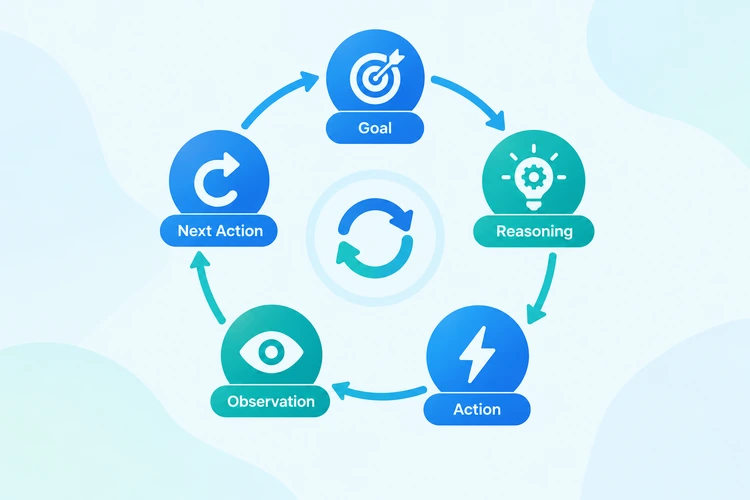
Most AI agents, regardless of framework or platform, follow a similar underlying loop.
Goal. The process starts with a defined objective, either given directly by a user or generated as a sub-goal within a larger task.
Reasoning and planning. The model considers what needs to happen to achieve the goal, breaking it into smaller steps or deciding which tool, if any, is needed next.
Action. The agent performs a step, such as calling an external tool, querying a database, or generating a piece of output.
Observation. The agent receives the result of that action, whether it's search results, an API response, or an error message.
Next action. Based on the observation, the agent decides what to do next: take another action, ask for clarification, or conclude that the goal has been reached.
This loop can run once or many times depending on task complexity. A simple agent might complete a goal in a single action; a more complex one might cycle through several rounds before arriving at a final result.
AI Agents vs. Chatbots
It's easy to blur the line between a chatbot and an agent, especially since both are often built on the same underlying language models. The distinction is about behavior, not the model itself.
| Aspect | Chatbot | AI Agent |
|---|---|---|
| Interaction pattern | Single response per input | Multi-step loop until goal is met |
| Tool use | Typically none, or very limited | Can call external tools and APIs |
| Decision-making | Responds based on the prompt alone | Plans and adjusts actions based on results |
| Autonomy | Low; user manages each step | Higher; the system manages intermediate steps |
| Example | Answering "How do I reset my password?" | Actually looking up the account and resetting it |
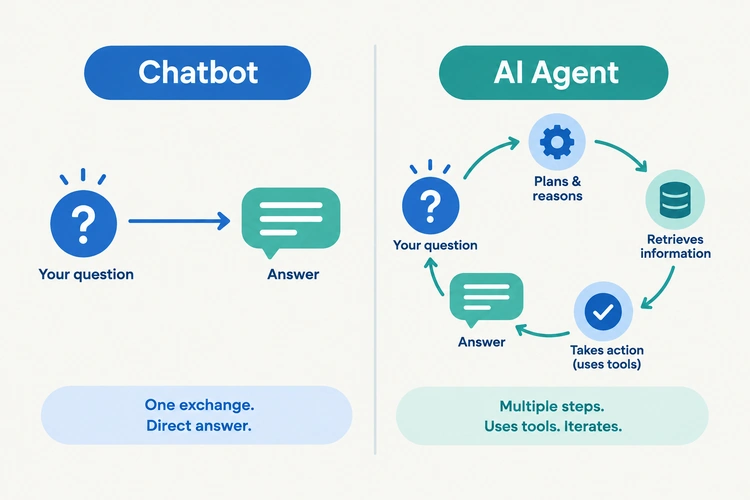
A chatbot can be very sophisticated in how it answers, but it isn't deciding to take independent action based on intermediate results. An agent's defining trait is that loop of acting, observing, and adjusting.
AI Agents vs. Traditional Automation
Agentic AI is also often confused with traditional automation, such as scripted workflows or robotic process automation (RPA). Both involve a system performing actions, but the underlying mechanism differs.
Traditional automation follows a fixed, predefined sequence every time, regardless of what it encounters, making it reliable but brittle when conditions change. An AI agent uses reasoning to decide what to do at each step based on the current situation, making it more adaptable but less deterministic.
In practice, many real systems combine both: agentic reasoning at decision points, wrapped around traditional automation for steps that don't need flexibility.
What Makes an Application "Agentic"?
Not every AI feature that uses tools or takes actions qualifies as agentic in a meaningful sense. A few characteristics generally distinguish a genuinely agentic application from a simple scripted assistant.
- Goal-directed behavior. The system works toward an outcome, not just a single output.
- Autonomous decision-making. The system chooses which actions to take, rather than following a fixed sequence set entirely in advance.
- Tool use. The system can interact with external resources, such as APIs, databases, or files, to gather information or perform tasks.
- Iterative reasoning. The system can revise its plan based on new information rather than committing to a single, unchangeable sequence of steps.
An application that simply calls one API based on a keyword match isn't really agentic, even if it looks similar on the surface. The presence of a reasoning and decision loop makes the difference.
Tools and External Systems
Tools are what allow an agent to do more than generate text. A tool, in this context, is any external function, API, or system the agent can call to gather information or take action, such as a web search function, a calculator, a database query, or a code execution environment.
The model doesn't "know" how to use a tool by default; it's given a description of what the tool does and decides when calling it is appropriate based on the current goal. The result becomes part of the information used for its next decision. Which tools an agent has access to, and how clearly they're described, has a direct effect on how reliably it behaves.
Memory and Context
For an agent to reason effectively across multiple steps, it needs some form of memory: access to relevant information from earlier in the task, not just the current input. This includes short-term context, such as results from previous actions, and in more advanced systems, longer-term memory that persists across sessions, such as user preferences.
Without adequate memory, an agent may repeat actions, lose track of results, or contradict earlier steps within the same task. As a task grows more complex, deciding what information to keep, summarize, or discard becomes increasingly important to both performance and cost.
RAG and AI Agents
Retrieval-Augmented Generation (RAG) and agentic AI are related but distinct concepts, and it's common to see them combined.
RAG gives a model access to relevant external knowledge by retrieving it before generating a response. An agent, meanwhile, takes a goal and acts on it through a sequence of steps. These ideas complement each other well: an agent might use retrieval as one of its available tools, searching a knowledge base as part of a larger task, rather than retrieval being the entire system.
For example, a customer support agent might retrieve relevant documentation using RAG, use a separate tool to check an order status, and then decide whether to escalate the case, all within a single agentic loop. Retrieval handles what the system knows; agentic reasoning handles what it should do next.
Single-Agent vs. Multi-Step Workflows
Not every agentic system needs multiple agents working together. A single-agent application uses one agent, equipped with the tools and reasoning ability it needs, to handle a defined task from start to finish. This is the most common and practical starting point for most real applications.
A multi-step workflow might involve a single agent progressing through several distinct stages within one task, such as researching, drafting, and reviewing a document. This differs from multi-agent systems, where multiple separate agents coordinate with each other, adding significant complexity around coordination and failure handling. For most practical purposes, a well-designed single agent is the foundation everything else builds on.
When Should You Use an AI Agent?
AI agents are a good fit when a task involves multiple unpredictable steps, requires interacting with external systems or data, benefits from adjusting course based on intermediate results, and doesn't require strict determinism at every step. Examples include a research assistant that searches multiple sources and synthesizes findings, a support tool that looks up account details and acts on what it finds, or a coding assistant that runs code, reads the error, and adjusts its approach.
When Should You Not Use One?
Agentic complexity isn't free, and it isn't always the right tool. A simpler approach is often better when the task is a single, well-defined step with a predictable outcome, when full determinism and auditability are required, such as in regulated financial transactions, when a traditional script or rule-based system already handles the task reliably, or when the cost and latency of multiple reasoning steps outweigh the benefit of flexibility.
A common mistake is reaching for an agent when a simple API call or a fixed script would do the job more reliably and at lower cost. Agentic design adds value when flexibility and reasoning are genuinely needed, not as a default choice for every AI feature.
Common Misconceptions About Agentic AI
A few misunderstandings come up often enough to address directly.
"Agentic AI means fully autonomous AI with no human oversight." Most well-designed systems include checkpoints, permissions, or human review, especially for consequential actions.
"More agents always means a better system." Multi-agent systems add coordination overhead and new failure modes. A single well-designed agent often outperforms a poorly coordinated multi-agent setup.
"Agentic AI eliminates the need for good prompt design." Agents still depend heavily on clear goals, well-described tools, and thoughtful context management.
"Agents are inherently unreliable." Agents are less deterministic than fixed scripts, but careful tool design and evaluation can make them reliable enough for many production use cases.
Skills Involved in Building AI Agents
Understanding agentic AI conceptually is different from being able to build a working agent. Doing so draws on a combination of skills: designing clear goals and constraints, defining tools so a model can use them correctly, managing context and memory across multiple steps, integrating retrieval where relevant, and evaluating agent behavior to catch unreliable actions early.
These skills build on concepts like prompt design and retrieval, but require additional practice with the decision-making and tool-use patterns specific to agentic systems.
Conclusion
Agentic AI represents a meaningful shift from AI that simply answers questions to AI that can pursue a goal through reasoning, action, and observation. Understanding the agent loop, how agents differ from chatbots and traditional automation, and when agentic complexity is actually warranted gives you a solid foundation for evaluating or building these systems, rather than treating "agent" as a buzzword applied to anything that calls an API.
Moving from understanding these concepts to building a working agent involves hands-on practice: designing tools, managing context, integrating retrieval, and testing how an agent behaves across realistic tasks. If you're looking for a guided learning path into this area, one structured way to build these skills is through Code Labs Academy's self-paced course, Agentic AI: Intro to Agent Development, which focuses on single-agent applications, tools, and practical projects.

Learn technical skills online with Code Labs Academy
Join our supportive community, unlock your potential, and embark on a rewarding career path.
Apply Now