
LLMOps vs MLOps: What's the Difference and Which Skills Do You Need?
Updated on October 22, 202610 minutes read
LLMOps is often described as "the new MLOps." That label is catchy, but it hides the useful part. The two fields share the same core goal, and they differ in where the hard problems show up.
This article compares them side by side. You'll see what carries over from MLOps, what LLM applications add, and which skills are worth learning first. If you're new to the topic, our beginner's guide to LLMOps covers the basic lifecycle. Here, we put that model to work.
LLMOps vs MLOps at a glance
MLOps (Machine Learning Operations) is the practice of taking machine learning models from a notebook into production and keeping them healthy. Think of a fraud detector, a demand forecast, or a product recommender.
LLMOps applies the same discipline to applications built on large language models, such as chatbots, writing assistants, and document Q&A tools.
In short, MLOps mostly operates a model that your team trained. LLMOps mostly operates an application built around a model someone else trained.
| Question | MLOps | LLMOps |
|---|---|---|
| What do you usually build? | Your own trained model | An app around a pre-trained LLM |
| What changes most often? | Training data and model versions | Prompts, context, and retrieved data |
| What does output look like? | A number, label, or ranking | Free-form text |
| How do you know it works? | Accuracy and similar metrics on test data | Scored evaluations, rubrics, and human review |
| Main running cost | Training and serving compute | Tokens per request and response time |
What MLOps traditionally handles
MLOps grew up around models that teams train themselves. A typical project looks like this: collect data, build features, train a model, test it, deploy it, and retrain it when performance slips.
The core MLOps jobs include:
- Data pipelines: collecting, cleaning, and versioning training data
- Experiment tracking: recording which data, settings, and code produced each model
- Model registry: storing approved model versions so you can deploy or roll back
- Deployment: serving the model through an API or a batch job
- Monitoring: watching for data drift, which is when live data stops looking like the training data
- Retraining: updating the model when accuracy drops
Take a churn model that predicts which customers might cancel. If customer behavior shifts after a price change, predictions get worse. MLOps catches the drift and kicks off retraining.
What LLMOps adds
With LLM apps, most teams don't train the model at all. They call a hosted model through an API or run an open-source one. The work moves from training to everything around the model.
That shift brings new moving parts:
- Prompts. Instructions written in plain language now act like code. One edited sentence can change thousands of answers.
- Context. The model only knows what you put in its input window. Choosing what goes in, and what stays out, becomes an engineering task.
- Retrieval. Many apps use RAG (Retrieval-Augmented Generation) to search your documents and feed the best matches to the model.
- Open-ended outputs. There's rarely one correct answer. A response can be accurate but too long, or friendly but wrong.
- Cost and latency per request. Hosted models typically charge by tokens (small chunks of text). Longer prompts and answers cost more and take longer.
Fine-tuning still exists in LLMOps, and some teams do it. But for many applications, prompts and retrieval are the first levers teams pull, because they are faster and cheaper to change.
Side-by-side comparison
Here is how the two compare across six areas of the lifecycle.
| Area | MLOps | LLMOps |
|---|---|---|
| Models | Train and own the model; pick algorithms and features | Choose a pre-trained model; sometimes fine-tune; switch providers or versions |
| Data and context | Training datasets and feature pipelines | Prompt templates, retrieved documents, conversation history |
| Evaluation | Fixed metrics such as accuracy, precision, recall | Test question sets, rubrics, LLM-as-a-judge, human review |
| Deployment | Package and serve the model | Ship app code, prompt versions, model settings, and the retrieval index |
| Monitoring | Data drift, prediction quality, uptime | Answer quality, hallucinations, token cost, latency, user feedback |
| Iteration | Retrain on new data | Edit prompts, fix retrieval, update documents, swap models |
Models
In MLOps, the model is your product. In LLMOps, the model is a component, and it can change under you. Providers update or retire model versions, so you need tests that tell you whether a new version helps or hurts your app.
Data and context
MLOps data is mostly used at training time. LLMOps data is often used at request time. Every question pulls fresh context into the prompt, so a stale document can cause a wrong answer today.
Evaluation
A churn model is right or wrong for each customer. A support answer can be partly right. LLM evaluation needs scoring rules that capture accuracy, tone, completeness, and safety.
Deployment
An MLOps release usually swaps one model file. An LLMOps release can change four things at once: code, prompt, model version, and the document index. Each should be versioned so you can tell which one caused a change.
Monitoring
Both fields watch uptime and errors. LLMOps adds quality signals for text, plus cost per request, since a small prompt change can raise your bill.
Iteration
MLOps improves mostly by retraining. LLMOps improves through many small, fast edits. That speed is useful, but it also makes careful testing more important.
Where MLOps and LLMOps overlap
The overlap is large, which is good news if you already know one field.
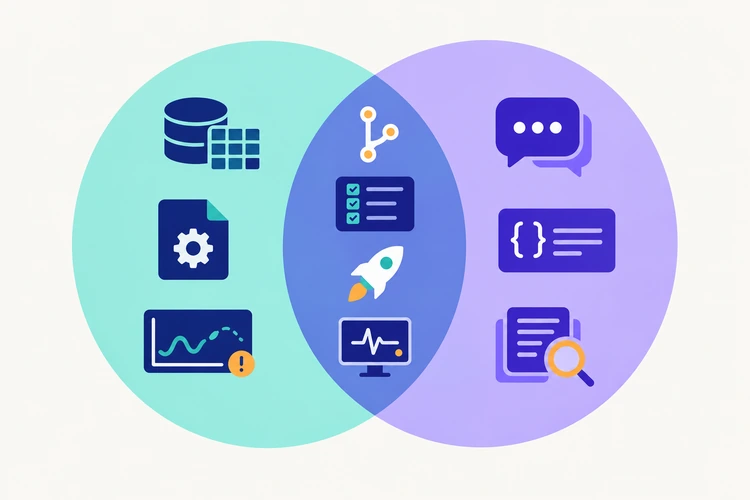
Both rely on version control for everything that affects output. Both need automated tests before release and a way to roll back. Both treat monitoring as a daily habit.
The same mindset carries over too. A model or app that looked fine in development will meet inputs nobody planned for. Teams in both fields build feedback loops to learn from those cases.
If you come from MLOps, skills like CI/CD, containerization, logging, and experiment tracking transfer directly. You'll mainly need to add prompt, retrieval, and text evaluation skills.
Why RAG creates additional operational complexity
RAG is where LLMOps differs most from classic MLOps. It adds a search system in front of the model, and that search system has its own failure modes.
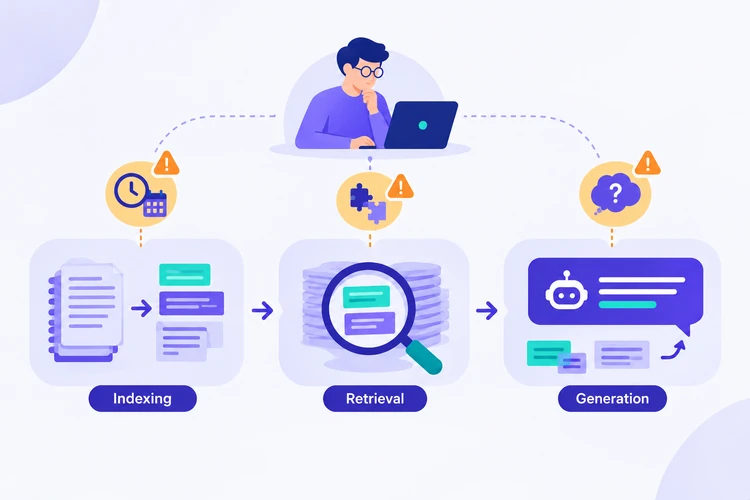
A RAG pipeline has two halves that can each break:
| Stage | What can go wrong | How you catch it |
|---|---|---|
| Indexing | Documents are outdated, missing, or split into poor chunks | Scheduled re-indexing; checks on document freshness |
| Retrieval | The search returns the wrong passages | Retrieval tests: does the right document appear in the top results? |
| Generation | The model ignores the context or adds facts | Groundedness checks: is every claim supported by retrieved text? |
Say an internal HR assistant answers, "You get 15 vacation days." The correct number is 20. Without tracing, you can't tell whether the policy document was outdated, the search pulled the wrong page, or the model made it up. Each cause needs a different fix.
In MLOps, there's no direct equivalent. A trained model doesn't look up documents at prediction time. That's why RAG needs its own tests and its own monitoring.
Evaluation and observability in LLM applications
In LLM applications, evaluation and observability work as a pair. Evaluation tells you how good the app is. Observability tells you why a specific answer turned out the way it did.
Evaluation in practice
Start with 30 to 50 real questions and a short scoring rubric. Mix in easy cases, edge cases, and questions the app should decline.
Score each answer with a mix of methods. Use simple code checks for format, an LLM-as-a-judge for qualities like relevance, and human review on a sample. Re-run the whole set before every prompt or model change.
Observability in practice
Observability comes from traces: a record of each step in one request. For a RAG app, a useful trace shows the user question, the retrieved passages, the final prompt with its version, and the answer with token count and latency.
MLOps monitoring often looks at averages across thousands of predictions. LLM observability adds the ability to open a single conversation and see exactly what happened. Both views matter.
Practical LLMOps workflow
Here is how a team might run the HR assistant from the example above. Several of these steps come straight from MLOps.
- Version everything. Store prompts as templates in Git with labels like
hr-assistant-v2. Record the model version and index date with each release. - Build the test set. Collect 40 real employee questions with the correct policy answers. Include questions about topics the bot should not cover.
- Set release gates. Agree on minimum scores before anything ships, for example correct policy figures on every vacation and leave question.
- Trace every request. Log the question, retrieved passages, prompt version, answer, cost, and latency.
- Watch live signals. Track daily cost, slow responses, and thumbs-down ratings. Sample a few conversations each week for human review.
- Turn failures into tests. When a user reports a wrong answer, find the cause in the trace, fix it, and add that question to the test set.
- Re-index on a schedule. Refresh the document index whenever HR updates a policy, then re-run retrieval tests.
Steps 1, 3, and 5 would look familiar to any MLOps engineer. Steps 2, 4, 6, and 7 are where LLM-specific skills come in.
Skills worth learning
You don't need every skill at once. This table groups them by how specific they are to LLM work.
| Skill area | Shared with MLOps | LLM-specific |
|---|---|---|
| Python and APIs | Yes | No |
| Git, CI/CD, and containers | Yes | No |
| Logging and monitoring | Yes | No |
| Experiment tracking | Yes | Applied to prompts and model choices |
| Prompt design and templating | No | Yes |
| RAG: chunking, embeddings, retrieval | No | Yes |
| LLM evaluation: test sets, rubrics, LLM-as-a-judge | No | Yes |
| Tracing and LLM observability | Partly | Yes |
| Cost and latency tuning | Partly | Yes |
A simple roadmap for most learners:
- Get comfortable with Python and calling an LLM API.
- Build a small app with a prompt template.
- Add basic RAG over a handful of documents.
- Write a test set and score your app.
- Add tracing and practice debugging bad answers.
- Learn deployment and monitoring basics as you go.
A structured option for hands-on practice
For readers who want hands-on practice with this roadmap, one structured option is Code Labs Academy's Fundamentals of LLMOps self-paced course. According to the course page, it's designed for beginners.
Learners build an LLM application with prompt templating and a Streamlit interface, then add a basic RAG pipeline with LangChain. From there, they evaluate, debug, and observe the app using Langfuse, and finish with a capstone project. It's one route among several. Official documentation, open-source projects, and your own side projects are also good ways to practice.
Which should you learn first?
It depends on what you build, or want to build.
Start with LLMOps if you're a software developer adding chatbots, assistants, or document search to products. You can build something useful without training a model, and you'll learn the shared ops habits along the way.
Start with MLOps if your work involves training custom models on structured data, such as forecasting, scoring, or classification. These projects are still common in production machine learning.
Already know MLOps? Focus on the LLM-specific column in the skills table: prompts, RAG, text evaluation, and tracing. Your existing skills give you a head start.
Neither path is a dead end. Some production systems combine both, such as a classic model that flags risky transactions and an LLM that writes a plain-language explanation for the reviewer. Knowing both makes it easier to work across those systems.
Conclusion and next steps
LLMOps builds on MLOps. It applies the same thinking to a new kind of system, one where prompts, context, and retrieved data shape every answer.
The shared foundation stays the same: versioning, testing, deployment, and monitoring. LLMOps adds prompt management, RAG, text evaluation, tracing, and close attention to cost and latency.
A good next step is to build something small. Pick a set of documents you know well, build a simple Q&A app, write 30 test questions, and trace every request. You'll learn more from fixing its first wrong answer than from any comparison table.
Learn technical skills online with Code Labs Academy
Join our supportive community, unlock your potential, and embark on a rewarding career path.
Apply Now