
How to Get Into Cybersecurity: Roadmap for 2026 Beginners
Updated on June 02, 20266 minutes read
Cybersecurity is one of the fastest-growing fields in technology, with millions of unfilled positions worldwide and salaries that consistently outpace other IT roles. More people are making the switch every year, including complete beginners with no prior technical background.
You do not need a four-year computer science degree to get started. What you need is a clear plan and the right skills built in the right order. This roadmap walks you through exactly how to get into cybersecurity in 2026, from your first day of learning to your first day on the job.
What Does a Cybersecurity Professional Do?
Cybersecurity professionals protect computer systems, networks, and data from unauthorized access, theft, and damage. Depending on the role, that might mean monitoring network traffic for threats, testing an organization's defenses for weaknesses, responding to active breaches, or writing security policies to meet compliance requirements.
The field spans a wide range of specializations. Some professionals focus on offensive security, ethically attacking systems to find vulnerabilities before real attackers do. Others work in governance, compliance, cloud security, or incident response. That variety means there is a path into cybersecurity for almost any background.
Do You Need a Degree?
The short answer is no. While some enterprise and government roles still list a degree as a preferred qualification, the industry has shifted toward skills-based hiring. Employers care far more about what you can demonstrate than what is on your diploma.
Practical, hands-on knowledge is what gets people hired. The ability to configure a firewall, analyze a packet capture, or identify a misconfigured server can be acquired through certifications, bootcamps, and consistent lab practice, without a traditional university program.
The Cybersecurity Roadmap for 2026
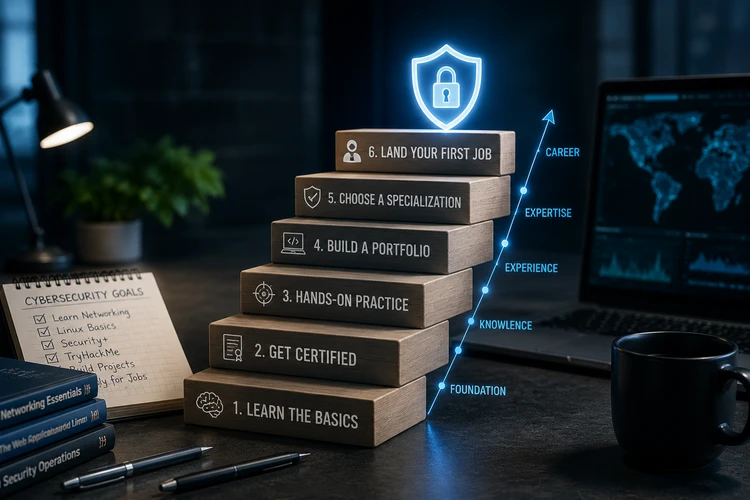
Step 1: Build a foundation in networking and operating systems
Before you can protect a network, you need to understand how it works. Learn how data moves across the internet, how protocols like TCP/IP and DNS function, and how operating systems like Linux and Windows are structured. Skipping this stage creates knowledge gaps that will cost you later. CompTIA's free study materials, Professor Messer's YouTube courses, and Linux command-line basics are solid starting points. Budget four to eight weeks here depending on your existing background.
Step 2: Earn your first certification
Certifications give your learning structure and signal foundational knowledge to employers. CompTIA Security+ is the standard first milestone for most beginners. It is vendor-neutral, broadly recognized, and covers the core concepts that appear in nearly every security role. Google's Cybersecurity Certificate on Coursera is a more accessible alternative for those who are newer to IT altogether. Once you pass your first cert, your specialization interest will become clearer, and you will know which credential to pursue next.
Step 3: Get hands-on with labs
Reading about security is not enough. Platforms like TryHackMe, Hack The Box, and Blue Team Labs Online provide simulated environments where you can practice real techniques safely and legally. TryHackMe is the most beginner-friendly; Hack The Box suits you better once you have some fundamentals in place. Aim for two to three labs per week. Consistent daily practice builds more skill than occasional marathon sessions.
Step 4: Choose a specialization
The most common entry-level path is SOC analyst, which involves monitoring systems, detecting threats, and responding to incidents. Penetration testing is more technical and usually requires prior experience in other security roles first. GRC (Governance, Risk, and Compliance) is accessible for people from non-technical backgrounds like business or law. Cloud security is the fastest-growing specialization as organizations move infrastructure to AWS, Azure, and Google Cloud. Choosing a direction early keeps your certifications, projects, and job applications focused.
Step 5: Build a portfolio
A portfolio gives hiring managers evidence that you can apply knowledge, not just recall it. Document your lab write-ups, write a vulnerability assessment of your home network, or build a basic SIEM setup using free tools. Host everything clearly on GitHub. A few well-documented projects will stand out far more than a long list of half-finished work.
Step 6: Start applying
Junior SOC analyst, IT security analyst, and cybersecurity support specialist roles are the realistic starting points for beginners. Do not wait until you feel completely ready. Apply when you have your first certification and a couple of portfolio pieces. Tailor your resume to each role, connect with security professionals on LinkedIn, and attend local or virtual security meetups. Many entry-level positions are filled through referrals rather than job boards.
How a Bootcamp Can Accelerate Your Path
Self-study is valid, but without structure it is easy to waste time on topics that will not help you get hired. A focused cybersecurity bootcamp compresses months of individual learning into a sequenced curriculum with expert instruction and built-in accountability.
Code Labs Academy's cybersecurity program is built for career changers and beginners. Students develop job-ready skills through real-world scenarios, build a portfolio with guided projects, and receive career mentoring and one-on-one advisor support throughout the program.
Download the cybersecurity course syllabus or talk to an advisor to see if the program fits your timeline and goals.
Key Certifications to Pursue in 2026
Entry level: CompTIA Security+ (most recognized starting point), Google Cybersecurity Certificate (more accessible and self-paced), CompTIA A+ for those completely new to IT.
Intermediate: CompTIA CySA+ for the SOC analyst path, Certified Ethical Hacker (CEH) for those heading toward penetration testing.
Advanced: CISSP requires five years of experience but is the most globally respected credential. OSCP is the gold standard for penetration testers. Focus on one or two certifications aligned to your target role rather than collecting as many as possible.
How Long Does It Take?
From complete beginner to first job, most people take between six months and two years. Someone already working in IT support can often reach an entry-level security role within six to nine months of focused study. Someone starting from zero should expect twelve to eighteen months studying part-time.
A typical part-time timeline: two months on networking fundamentals, two months preparing for Security+, one to two months on labs and portfolio work, then active job searching. A structured bootcamp compresses this considerably.
Is Cybersecurity a Good Career in 2026?
By almost every measure, yes. ISC2's research puts the global cybersecurity workforce shortfall at more than four million professionals, a number that has grown for a decade. Demand is structural, not a trend.
Entry-level SOC analyst roles in the US typically start between 55,000 and 75,000 dollars per year. Senior roles such as security architect or penetration tester regularly exceed 120,000 dollars. Remote work is common, opportunities exist across every industry, and the work itself is genuinely engaging as no two incidents are ever the same.
Conclusion
Getting into cybersecurity in 2026 is achievable for motivated beginners. Start with networking fundamentals, earn your first certification, practice consistently in hands-on labs, build a focused portfolio, and begin applying before you feel completely ready.
If you want a faster and more structured route, Code Labs Academy's cybersecurity bootcamp takes you from beginner to job-ready with a curriculum built around real employer needs, project-based learning, and career support throughout the process.
Explore the cybersecurity bootcamp programs at Code Labs Academy or apply today to speak with an enrollment advisor about your next step.