
EU AI Act Article 4: What the AI Literacy Requirements Mean for Employers in 2026
Updated on August 26, 20268 minutes read
Introduction: Why Article 4 Matters Now
If your organisation uses AI tools at work, from chatbots to hiring software, a quiet but binding EU rule already applies to you. It's called Article 4 of the EU AI Act, and it concerns AI literacy.
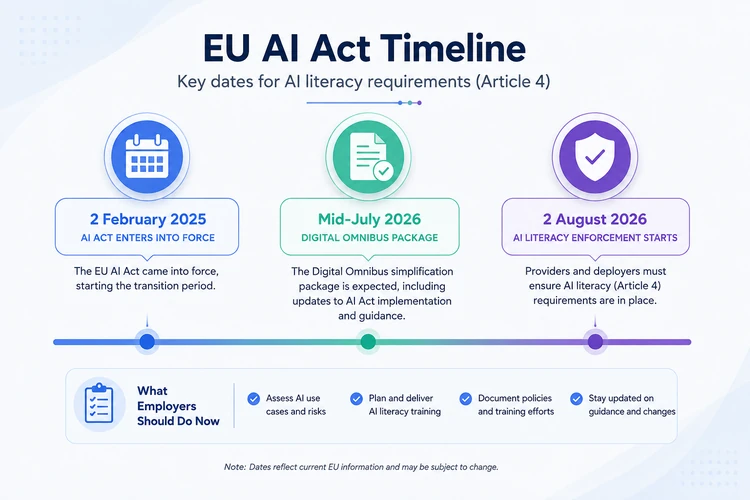
Article 4 has technically applied since 2 February 2025. But two developments have pushed it back into the spotlight in 2026: an amendment through the EU's Digital Omnibus on AI, which entered into force in mid-July 2026, and the start of national supervision and enforcement from 2 August 2026. For employers, this is the moment to check whether their AI literacy efforts are actually in place.
This article explains, in plain language, what Article 4 requires, what it does not require, and what employers should realistically be doing in response.
What Is Article 4 of the EU AI Act?
Article 4 sits within the EU AI Act (Regulation (EU) 2024/1689), the world's first comprehensive AI law. Its core text requires providers and deployers of AI systems to take measures to support the development of AI literacy among their staff and other people who deal with AI systems on their behalf.
The obligation takes into account each person's technical knowledge, experience, education, and training, as well as the context in which the AI system is used. In other words, the law does not prescribe a single fixed standard. It asks organisations to match their measures to their own situation.
One nuance worth noting: the original 2024 text asked organisations to ensure "to their best extent a sufficient level" of AI literacy. Following the Digital Omnibus amendment that took effect in mid-July 2026, the wording now asks organisations to "support the development of" AI literacy, and it explicitly states that no specific individual level of literacy needs to be guaranteed. The duty remains binding, but it has been reframed to be more flexible for organisations of every size.
What Does the AI Literacy Requirement Actually Mean?
In legal terms, "AI literacy" is defined in the AI Act as the skills, knowledge, and understanding that allow providers, deployers, and affected people to make informed decisions about AI systems, and to be aware of the opportunities, risks, and possible harms AI can cause.
This is broader than technical training. It includes understanding what an AI system is doing, recognising its limitations (such as the risk of inaccurate or "hallucinated" outputs), and knowing when human judgement should override an AI-generated result.
According to the European Commission's official Q&A on Article 4, the obligation does not require organisations to formally measure or test employees' AI knowledge. It requires organisations to take reasonable, proportionate steps to build that knowledge over time.
Who Is Covered?
Article 4 applies to two groups defined in the AI Act: providers (organisations that develop or place AI systems on the market) and deployers (organisations that use AI systems in their own operations). Most employers fall into the deployer category simply by using AI-powered tools at work.
The obligation extends beyond direct employees. The Commission's guidance clarifies that it also covers other people acting on the organisation's behalf, such as contractors, service providers, or clients, when they are involved in operating or using an AI system tied to the organisation.
The rule applies regardless of company size. A small business using a single AI writing tool and a multinational bank running dozens of AI systems are both in scope, though, as explained below, what "appropriate" measures look like will differ considerably between the two.
What Does AI Literacy Look Like in Practice?
The European Commission has outlined a practical starting framework organisations can use to think through their obligations under Article 4. It suggests four broad steps: build a general understanding of AI within the organisation (what it is, how it works, where it is used); clarify the organisation's role as a provider or deployer; assess the risk level of the AI systems in use, since higher-risk systems call for more thorough measures; and translate this analysis into concrete actions tailored to different roles, based on each person's existing technical background and the context in which the AI system is used.
Does the EU Require AI Training or Certification?
This is one of the most common misconceptions about Article 4, and it is worth stating clearly: the European Commission has confirmed, in its official Q&A, that no certificate is required to comply with Article 4. There is also no single mandated curriculum, no fixed number of training hours, and no EU-approved course that automatically satisfies the obligation. The Commission's guidance states there is no one-size-fits-all format, and that requirements depend on the concrete context an organisation operates in.
What is expected instead is that organisations keep some internal record of the training or guidance measures they have taken: evidence that reasonable, context-appropriate steps were taken, rather than proof of a specific credential. The Commission has also published a living repository of more than 40 real-world AI literacy practices from companies and public bodies, intended as inspiration rather than a compliance checklist. Replicating an example from the repository does not, on its own, guarantee compliance.
One further point matters for employers using higher-risk AI systems. Article 26 of the AI Act separately requires deployers of high-risk systems to ensure staff are sufficiently trained to handle those systems and exercise human oversight. That obligation stands alongside, and is more specific than, the general literacy duty in Article 4.
What Employers Should Do Now
Given that formal supervision and enforcement began on 2 August 2026 under national market surveillance authorities in each EU member state, employers are well advised to move from awareness to action. A few practical, low-friction steps stand out.
Start by mapping which AI tools are actually used across the organisation, including tools employees may have adopted informally, such as free chatbot accounts used for drafting text. It is difficult to build literacy around systems that have not first been identified. Next, group employees by how they interact with AI, such as occasional users, regular users, and technical staff who build or configure systems, since the depth of training reasonably differs across these groups. Then document whatever measures are taken, even informally, since a written record is what regulators and, potentially, courts will look for if a dispute arises.
Finally, revisit AI literacy measures periodically. Because the underlying technology, and the tools used inside most organisations, changes quickly, a one-off induction session is unlikely to remain adequate for long.
What Skills Employees Need
While Article 4 does not prescribe a specific skills list, the Commission's guidance and the AI Act's definitions point toward a consistent set of practical competencies. These include a basic understanding of how the AI tools they use generate output, awareness that outputs can be inaccurate or biased, and the judgement to know when a human should review or override an AI-assisted decision. Employees should also understand the specific limitations of the tools they personally rely on. A general-purpose chatbot used for translation or advertising copy, for example, can still produce factually wrong content.
For employees with more AI-intensive roles, additional understanding of data protection, applicable Union or sector rules, and the ethical implications of AI-assisted decisions becomes more relevant, particularly where the tools involved are classified as higher-risk under the Act.
It is worth distinguishing this everyday literacy from AI expertise. Literacy is about equipping ordinary staff, including marketers, HR teams, and customer service agents, with enough understanding to use AI tools responsibly. Expertise refers to the deeper technical knowledge held by data scientists or AI system developers. The Commission's guidance notes that people with a relevant AI degree or professional experience can generally be considered AI literate without additional formal action, though organisations should still confirm this knowledge extends to the specific systems in use. Most employers do not need to turn every employee into an AI specialist; the legal bar is proportionate awareness, not technical mastery.
Practical Examples of AI Literacy in the Workplace
A marketing team using a generative AI tool to draft social media posts should understand that the tool can produce plausible-sounding but false claims, and should review output before publishing rather than treating it as reliably accurate.
An HR department using AI to screen job applications should understand the potential for bias in automated shortlisting and should keep a human reviewer meaningfully involved in final decisions, particularly given that many recruitment AI tools may fall under the Act's high-risk category.
Conclusion
Article 4 of the EU AI Act asks something relatively modest of employers: take reasonable, proportionate steps so that people using AI at work understand what it can and cannot do. It does not require a certificate, a fixed curriculum, or a dedicated AI compliance officer.
What it does require is genuine, documented effort: mapping AI use, tailoring guidance to different roles, and keeping that guidance current as tools evolve. With national authorities now empowered to supervise and enforce the rule from August 2026 onward, organisations that have not yet formalised even a basic AI literacy approach have good reason to start now.
Sources
European Commission, AI talent, skills and literacy, Shaping Europe's Digital Future
European Commission, AI Literacy - Questions & Answers, official Article 4 Q&A
European Commission, Repository of AI Literacy Practices
Regulation (EU) 2024/1689 (the EU AI Act), Official Journal of the European Union, EUR-Lex
Regulation (EU) 2026/1744, Digital Omnibus on AI, EUR-Lex