
The Rise of AI-Native Jobs: 7 Emerging Tech Roles to Watch in 2026
Updated on September 02, 20269 minutes read
Introduction
New job titles rarely appear overnight, but over the past two years a cluster of AI-native roles has moved from niche to mainstream on hiring platforms. LinkedIn's January 2026 analysis found that AI has already added more than 1.3 million new roles, with titles like AI Engineer, Forward-Deployed Engineer, and Data Annotator among the fastest-growing on the platform.
These are not simply rebranded data science or software jobs. They reflect what companies actually need now: people who can deploy AI reliably, secure it, manage it as a product, and keep it running in production. This article looks at seven of these roles based on 2025 to 2026 hiring data, along with the skills and background that tend to open the door into each one.
Why AI Is Creating New Types of Tech Roles
Advanced AI models are now widely available as commodity APIs, from Claude and GPT to Gemini and open-weight alternatives like Llama. Building a capable model is no longer the bottleneck it was a few years ago. The harder problem is wiring that capability into a real business workflow, securely and reliably.
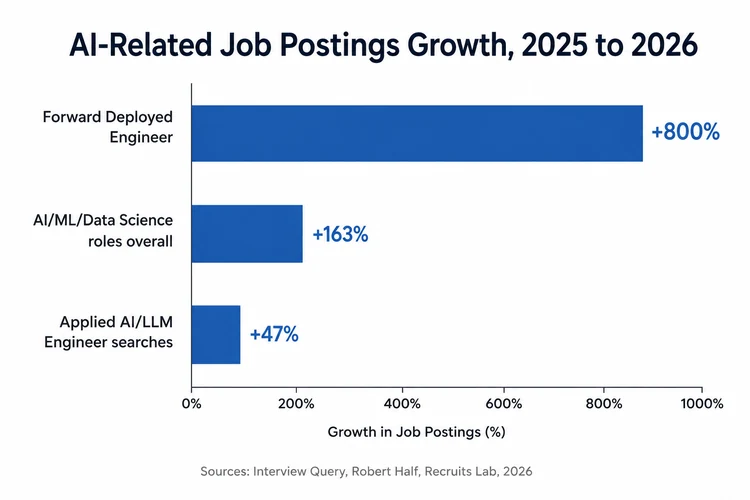
That shift, from training capability to deployment capability, is what recruiting analysts describe as the core driver of 2026's AI hiring boom. Robert Half's 2026 tech hiring report found AI, machine learning, and data science roles collectively reached 49,200 open positions, a 163% year-over-year increase, while LinkedIn's Skills on the Rise 2026 report ranked AI literacy, prompt engineering, and applied model skills among its fastest-growing skill categories.
Seven Emerging Roles
1. Forward Deployed Engineer
A Forward Deployed Engineer, or FDE, is a technical specialist embedded inside a customer's environment to scope, build, and ship an AI system end to end. The model, pioneered by Palantir, has since spread to AI labs and applied-AI startups including OpenAI, Anthropic, and Databricks. Job postings for the role grew roughly 800% between January and September 2025, according to Interview Query's January 2026 analysis, a trajectory that has continued into 2026.
The role exists because enterprise AI deployments often fail for organisational reasons rather than technical ones, and an embedded engineer clears those blockers faster than a traditional vendor model. Typical work includes scoping a customer's problem, writing production code, and maintaining the system after launch. Useful technical skills include Python, TypeScript, SQL, and cloud fluency; useful non-technical skills include customer discovery and clear communication with both engineers and business stakeholders. It suits engineers who enjoy variety and direct customer contact. A good starting point is shipping small, complete AI-integrated projects rather than isolated model experiments.
2. AI Engineer (Applied and LLM-Focused)
AI Engineer, distinct from the older Machine Learning Engineer title, has become one of the fastest-growing job titles in tech, according to Dice's January 2026 ranking. Where an ML Engineer historically trained models, an AI Engineer more often integrates existing models into products, building retrieval-augmented generation (RAG) pipelines and connecting large language models to internal data. Recruits Lab's 2025 search data found applied AI and LLM engineer searches grew 47% year over year.
Useful skills include familiarity with frameworks like LangChain, vector databases, and API integration, alongside solid general software engineering. Product thinking and the judgement to know when an AI feature is reliable enough to ship matter just as much. This role suits software engineers who want to specialise in AI without moving into full research work. A practical starting point is building a small RAG-based tool or adding an AI feature to an existing app.
3. MLOps Engineer
MLOps Engineers are the reliability counterpart to AI Engineers: where an AI Engineer ships a feature, an MLOps Engineer keeps it running, scaling, and observable in production. LinkedIn's Emerging Jobs research identified MLOps as one of the steepest growth curves in tech, at roughly 9.8 times growth over five years.
Responsibilities typically include managing deployment pipelines, monitoring model performance and drift, and ensuring systems meet reliability standards. Useful skills include cloud infrastructure experience, containerisation tools such as Docker and Kubernetes, and CI/CD pipeline management for ML workloads, alongside clear incident communication. This role suits engineers with a DevOps or infrastructure background. A practical starting point is deploying and monitoring an open-source model end to end.
4. AI Product Manager
AI Product Manager is one of the largest non-engineering growth areas in AI hiring. Recruits Lab's 2025 data found AI product manager hiring grew 41% year over year, blending traditional product management with a working understanding of AI system behaviour and limitations.
Responsibilities typically include defining product strategy for AI-powered features and translating ambiguous AI capabilities into concrete, testable requirements. Because AI outputs are probabilistic rather than deterministic, AI Product Managers also need to think about failure modes and how to communicate AI limitations honestly to users. Useful skills include a working understanding of how large language models behave, basic familiarity with evaluation metrics, and strong stakeholder communication and prioritisation. This path suits existing product managers looking to specialise, or technical professionals moving toward a more strategic role. A good starting point is studying how existing AI products handle edge cases and failure states.
5. AI Security and Governance Specialist
AI security has emerged as a distinct specialisation, separate from general cybersecurity, growing out of red-teaming work in 2024 and a wave of agent-related security incidents in 2025. Typical responsibilities include prompt injection defence, securing agent identity and access controls, and governing fine-tuning data. Demand comes from both compliance-driven enterprise buyers and platform vendors building AI-specific security tooling. Frameworks such as ISO 42001, the NIST AI Risk Management Framework, and regional regulation like the EU AI Act are increasingly cited in job postings for this role.
Useful skills include a solid grounding in traditional cybersecurity, plus specific knowledge of AI-related risks such as prompt injection and data or model poisoning, along with the ability to translate technical risk into business-relevant language. This role suits security professionals looking to specialise, or compliance-minded professionals building deeper technical AI knowledge. A reasonable starting point is studying published AI risk frameworks and recent agent security case studies.
6. Agent Engineer
Agent Engineer is one of the newest roles on this list, formalised in late 2025 alongside agent development frameworks such as Google's Agent Development Kit, Anthropic's Claude Agent SDK, and LangGraph. It combines elements of AI engineering, MLOps, and backend engineering, and exists because most production AI work in 2026 involves autonomous or semi-autonomous agents carrying out multi-step tasks, rather than single-turn generative interactions alone.
Typical responsibilities include designing agent workflows, managing tool use and permissions, and handling error recovery when an agent's actions go wrong. Useful skills include experience with agent orchestration frameworks, strong backend fundamentals, and careful risk thinking, since agents that take real-world actions carry different failure implications than a chatbot that only generates text. This role suits engineers who enjoy systems design and are comfortable with tooling that is still evolving. A practical starting point is building a small agent-based project and documenting how it handles failure cases.
7. AI Trainer and Data Annotation Lead
Data annotation and model training oversight is a less visible but strategically important category. Joint World Economic Forum and LinkedIn data on the 1.3 million new AI jobs specifically names Data Annotators as one of three role categories driving that growth, alongside AI Engineers and Forward-Deployed Engineers.
At an individual contributor level, this work involves labelling data and evaluating model outputs for quality. At a senior level, an AI Trainer or Annotation Lead designs the feedback loops and quality processes that shape model behaviour, particularly for domain-specific applications like legal, medical, or financial AI tools. Compensation varies significantly by seniority, with individual annotators typically paid hourly and senior leads earning well into six figures. Useful skills include familiarity with annotation tooling and, at a senior level, an understanding of how training data quality affects model behaviour, alongside genuine domain expertise. This path suits professionals with deep expertise in a specific field rather than a purely technical route. A good entry point is contract annotation work in a subject area of real expertise.
Skills These Roles Have in Common
Despite covering different parts of the AI stack, these roles share consistent threads. Nearly all require baseline technical fluency, whether that means writing production code, understanding model behaviour, or working with data pipelines, even in roles like AI Product Manager that are not purely engineering positions.
Just as consistently, none of these roles reward technical skill in isolation. Communication, judgement about failure modes, and the ability to work directly with customers or cross-functional teams appear across nearly every current job description. Screening has also shifted noticeably: Recruits Lab's 2025 to 2026 hiring data found that shipped work product increasingly outweighs formal credentials or employer pedigree when companies evaluate candidates for AI-native roles.
How to Prepare for Emerging AI Careers
Because these roles are new and still evolving, effective preparation tends to look different from traditional tech career paths. Building small, complete, end-to-end projects, rather than isolated coursework or certifications, appears to be the strongest signal across nearly all of these roles, since employers are explicitly screening for demonstrated work over credentials.
For most of these roles, deep specialisation in AI theory matters less than applying existing AI tools to real, specific problems. Following the actual frameworks referenced in current job postings, such as LangChain, RAG architectures, agent orchestration tools, and published AI risk standards, is generally more useful than broad, generic AI courses. For roles like AI Security Specialist or AI Trainer, existing domain expertise, whether in cybersecurity, a regulated industry, or a specific subject area, can be a genuine advantage over starting from a purely technical background.
Conclusion
The seven roles outlined here are not simply existing technology jobs with an "AI" prefix attached. Each reflects a specific shift in what AI adoption actually requires: reliable deployment, ongoing operation, product judgement, security, and quality control at scale. For professionals considering a move into this space, the clearest path forward is not a single certification, but demonstrated, shipped work that shows you can apply AI tools to a real problem, combined with the communication and judgement skills that remain distinctly human contributions to these roles.
Sources
LinkedIn, The 20 New Agentic AI Jobs Box, McKinsey, and LinkedIn All See Coming, reported via Forbes
Interview Query, cited in AI Engineering Jobs 2026: The 800% Surge Reshaping Tech
Forward Deployed Engineer: 2026 AI Hiring Guide
2026 FDE Hiring Trends: What 1,000 Job Posts Reveal, Perspective AI
What AI Companies Are Actually Hiring For in 2026, Recruits Lab
Emerging AI Roles for 2026: Where the Hiring Is, and What It Pays, Tek Ninjas
Robert Half, 2026 Tech Hiring Report, cited via Tek Ninjas