
AI in Healthcare 2026: From Imaging to Patient Flow Optimization
Updated on January 05, 202614 minutes read
Hospitals and clinics are facing a tough mix in 2026: more patients, tighter budgets, and teams stretched thin. At the same time, patients expect faster answers, smoother scheduling, and fewer “please repeat your story” moments. The gap between demand and capacity is now a daily operational problem.
If you’re considering a career change into tech or want to upskill into a more future-proof role, healthcare is one of the most impactful places to build. It’s also one of the most complex, which is exactly why skilled professionals are needed. This article breaks down where the real opportunities are, from imaging to patient flow.
Rather than focusing only on futuristic headlines, we’ll look at what healthcare organizations actually deploy: tools that support clinicians, reduce bottlenecks, and improve how care moves through the system. You’ll also learn which tech skills translate best, and how to build a portfolio that signals you can work in regulated, high-stakes environments.
What’s different about healthcare technology in 2026
A big shift in 2026 is that health systems are measuring success less by “cool demos” and more by operational outcomes. Leaders want shorter wait times, fewer delays, and safer handoffs between teams. That pushes technology from experimentation into day-to-day workflows.
Another change is integration maturity. Many hospitals still struggle with fragmented systems, but more vendors now expose APIs and standardized interfaces. When data moves more reliably, analytics and automation can actually influence decisions instead of sitting in a dashboard no one checks.
Finally, healthcare has learned (sometimes the hard way) that adoption matters as much as accuracy. Tools that fit real workflows, without adding clicks or uncertainty, are the ones that survive. This is great news for career changers because it increases demand for practical builders, not only researchers.
Imaging in 2026: moving from detection to workflow support
Imaging remains one of the most visible areas of innovation because it produces rich, structured data. But in 2026, the highest-value improvements often come from improving the workflow around imaging. Think about getting the right scan to the right clinician at the right time, with fewer avoidable delays.
Worklist prioritization and faster time-to-read
Radiology teams manage large queues of studies every day. Workflow tools can help prioritize cases that look urgent, so they rise to the top of the worklist. When designed well, this can reduce time-to-diagnosis for time-sensitive conditions.
The key point is that prioritization is a workflow decision, not a final diagnosis. It’s about triage signals and probability, paired with clear escalation rules. That makes it a strong area for product-minded data professionals who understand thresholds, tradeoffs, and monitoring.
Quality checks that prevent repeat scans
A surprisingly common source of delay is low-quality images that require a repeat scan. Quality checks can flag motion artifacts, incorrect positioning, or missing views before the patient leaves. That reduces rescheduling, improves throughput, and lowers patient frustration.
For technologists, this is a practical, measurable problem. The metrics aren’t abstract: repeat scan rates, time lost per repeat, and downstream delays. It also highlights how “small” improvements can produce system-wide wins.
Protocol guidance and decision support
Imaging isn’t just about reading images; it starts when a clinician chooses which study to order. Tools can support protocol selection by using clinical context and prior studies to suggest the most appropriate next step. This helps reduce unnecessary scans and speeds up the right testing pathway.
This is also where interoperability becomes critical. Decision support requires structured access to prior imaging, lab results, and symptoms. The best solutions combine data engineering with careful interface design so clinicians can verify recommendations quickly.
Reporting workflow: structure, consistency, and handoffs
Even when an image is read correctly, the report must be clear and actionable. In 2026, many teams focus on making reports more structured and consistent, so the next clinician can act without confusion. Improvements include better templating, faster summarization, and clearer critical-result communication.
From a tech perspective, this blends data, UX, and safety. A “helpful” feature becomes harmful if it introduces ambiguity or makes it harder to find the key finding. That’s why testing with real users matters as much as model performance.
What imaging tools still struggle with
Imaging environments vary across scanners, settings, and patient populations. Edge cases, rare conditions, and imaging artifacts can all impact performance. That’s why robust deployment requires monitoring, fallbacks, and clear human oversight.
In practice, the most trusted tools are those that know their limits. They surface confidence, suggest next actions, and make it easy for clinicians to override or correct. This is a strong theme across healthcare in 2026: reliability beats novelty.
Beyond imaging: the operational “middle” where care slows down
The patient experience is shaped by more than clinical decisions. It’s shaped by scheduling, documentation, referrals, and whether teams can coordinate without delays. In 2026, many health systems invest heavily in operational improvements because they reduce costs and improve access at the same time.
Documentation support is a big example. Clinicians often spend hours charting, which reduces time with patients and increases burnout. Tools that help draft notes, summarize visits, and structure information can reduce administrative load when they are designed for verification and accountability.
Coding and revenue cycle operations are another major area. Accurate coding affects reimbursement and compliance, and small changes can have an outsized financial impact. This creates demand for analysts and engineers who can work with structured data, build reliable pipelines, and collaborate with non-technical stakeholders.
Patient flow optimization: where the biggest system-wide impact happens
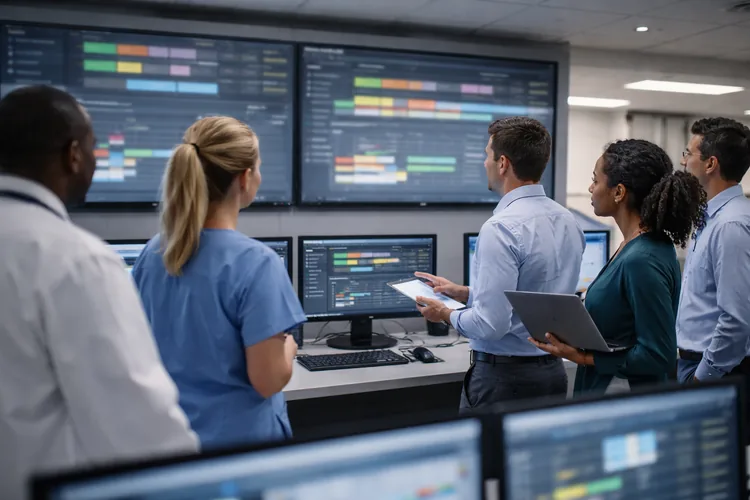
Patient flow is the art and science of moving patients through care efficiently and safely. In 2026, it’s a top priority because flow problems cascade: a crowded emergency department affects inpatient beds, which affects surgery schedules, which affects staff workload and patient satisfaction.
Flow optimization isn’t one model or one dashboard. It’s a set of decisions across the care journey, supported by forecasting, queue management, and operational coordination. The best teams treat it as a product, not a one-off project.
Demand forecasting for smarter planning
Hospitals need to anticipate demand to staff appropriately and avoid “surprise” surges. Forecasting can estimate emergency arrivals, inpatient census, ICU utilization risk, and expected discharges. Even moderate improvements can reduce overtime and last-minute scrambling.
What makes forecasting valuable is actionability. A forecast is only useful if it ties to decisions like opening overflow capacity, adjusting triage staffing, or scheduling elective procedures more strategically. This is where data science meets operations leadership.
Emergency department throughput and triage flow
The emergency department is often where flow breaks first. Bottlenecks can occur at triage, lab turnaround, imaging availability, specialist consults, and bed assignment. Flow tools can highlight where delays form and suggest operational interventions.
The best systems avoid blaming individuals and focus on process constraints. They help teams see patterns over time, compare shifts, and test changes with measurable outcomes. That creates a powerful space for analysts and product-minded engineers.
Bed management and “the discharge problem.”
Bed availability isn’t just capacity; it’s timing. A bed might exist on paper, but it may be unavailable due to cleaning, staffing, isolation status, or unit specialization. Discharge delays are especially impactful because they block upstream admissions and increase ED boarding.
In 2026, many hospitals use discharge prediction and barrier tracking. These tools can identify patients likely tobe dischargede soon and flag what’s blocking the discharge. The goal is earlier coordination: transport, pharmacy, home health, and follow-up scheduling.

Operating room scheduling and downstream constraints
Operating rooms are high-cost, high-impact resources. Scheduling has to account for surgeon availability, staffing, equipment, pre-op testing, and recovery bed capacity. A delay in one procedure can ripple across the entire day.
Optimization here often looks like constraint-aware scheduling and better prediction of case durations. It’s a great fit for people who enjoy systems thinking and who can communicate tradeoffs clearly to stakeholders.
Outpatient access, no-shows, and clinic efficiency
Flow is not only inpatient. Outpatient clinics struggle with no-shows, uneven appointment demand, and long wait times for certain specialties. Smarter scheduling can reduce wasted capacity and improve patient access.
In practical terms, this might include no-show risk prediction, waitlist automation, and appointment slot optimization by visit type. These are measurable improvements that connect directly to patient experience and clinic revenue.
Command centers and operational dashboards
Some health systems run centralized “command centers” that monitor capacity and throughput across units. The goal is shared visibility: admissions, discharges, bed status, staffing constraints, and predicted surges. When done well, this reduces confusion and speeds up coordination.
For technologists, command-center work emphasizes data integration, reliability, and UX clarity. Dashboards must be fast, accurate, and usable under pressure. That often matters more than fancy visuals.
The foundation that makes all of this possible: data and interoperability
Healthcare technology lives or dies on data movement. Imaging systems, EHRs, labs, scheduling, staffing, and billing tools often come from different vendors. Patient flow optimization depends on combining these sources into something consistent and trustworthy.
In 2026, interoperability is improving, but it still requires real engineering work. Data arrives late, fields change, identifiers don’t match cleanly, and operational definitions vary across departments. This is why strong SQL and data modeling skills are extremely valuable in healthtech.
If you want to stand out, learn to handle messy reality. Build pipelines that validate inputs, log anomalies, and produce auditable outputs. In regulated environments, “it usually works” is not a sufficient standard.
Privacy, security, and safety: non-negotiables in healthcare
Healthcare data is sensitive, and systems must earn trust. That means building with access control, auditing, and secure defaults from day one. Security isn’t a separate phase; it’s part of the design.
Safety is equally important. In high-stakes workflows, a confusing UI or an overconfident recommendation can cause harm. Teams need testing, monitoring, incident response plans, and clear policies for when tools fail or data is missing.
Fairness also matters because healthcare populations are diverse. Evaluations should check performance across demographic groups, device types, and different care settings. Responsible teams treat this as ongoing work, not a one-time checkbox.

Career opportunities in 2026: where you can fit in healthcare tech
Healthcare needs a wide range of technical roles, and many do not require a medical background. The most successful career changers tend to bring strong problem-solving skills and a willingness to learn in the healthcare context. Communication and reliability are often your biggest differentiators.
Data analyst (healthcare operations)
Operational analysts turn messy throughput data into decisions. They track KPIs like length of stay, wait times, and discharge delays, then work with teams to test improvements. Strong SQL, dashboarding, and stakeholder communication are the core skills here.
This role is often a great entry point into healthtech. It builds domain knowledge fast and creates a clear story for interviews: “Here’s the bottleneck, here’s what we changed, here’s the measurable outcome.”
Data engineer (clinical and operational data)
Data engineers build the pipelines that make analytics and automation possible. They integrate sources, manage transformations, and ensure data quality. In healthcare, they also handle lineage, auditability, and strict access controls.
If you like building systems that other teams depend on, this can be a high-impact path. It’s also one of the most durable roles because every healthcare organization struggles with a reliable data infrastructure.
Machine learning practitioner (applied healthcare)
Applied ML work in healthcare often centers on forecasting, risk stratification, triage support, and workflow prioritization. Success depends on evaluation design, monitoring, and careful integration into real decisions. Communication is critical because stakeholders need to understand tradeoffs.
This role isn’t only about training models. It’s also about setting thresholds, defining safe fallbacks, and proving that the tool improves operations without creating new risks.
Software engineer (health platforms and integration)
Software engineers build the interfaces and services clinicians and staff use daily. That includes authentication, APIs, role-based access, and reliability engineering. Performance and uptime matter a lot because downtime disrupts care.
This path is ideal if you enjoy shipping products and improving user experience. Healthcare rewards engineers who can balance speed with rigor and who take security seriously.
UX/UI designer (clinical workflow design)
Design in healthcare is different from consumer design because the stakes are higher and the environments are stressful. Designers must reduce cognitive load, prevent errors, and make complex information easy to scan. Small improvements can save minutes per patient and reduce burnout.
If you enjoy research, prototyping, and simplifying complexity, healthcare UX can be a meaningful niche. A portfolio that shows workflow thinking can stand out quickly.
Cybersecurity specialist (healthcare security)
Hospitals are frequent targets, and incidents can disrupt patient care. Security professionals help protect data, ensure resilience, and guide safe operations. This includes identity and access management, incident response, and secure system architecture.
Healthcare security is especially compelling if you want to work with clear, real-world impact. It’s also a space where certifications and hands-on labs can meaningfully strengthen your profile.
Skills roadmap: what to learn to work on imaging and patient flow
If your goal is to work on AI in healthcare 2026 initiatives that touch imaging workflows or patient flow optimization, start with a strong foundation. Employers care that you can deliver reliable outputs and explain your choices. Flashy models without operational fit won’t get traction.
Start with Python and SQL, then add statistics and data visualization. These skills appear in nearly every healthcare tech role, from analytics to engineering to product. They also help you build portfolio projects that are easy for hiring managers to evaluate.
Next, choose a specialization direction. For imaging, you’ll benefit from computer vision fundamentals and evaluation thinking. For patient flow, time series forecasting and constraint-aware problem solving are often more relevant than deep vision work.

Portfolio projects that hiring teams recognize (without private patient data)
A strong portfolio is your proof of readiness, especially if you’re changing careers. The goal is not to mimic a hospital’s proprietary system. The goal is to demonstrate the same reasoning, structure, and reliability that healthcare teams need.
1) Patient flow forecasting dashboard
Build a forecast for arrivals or inpatient census using a public dataset or realistic synthetic data. Show error metrics, but also show how the forecast would change staffing or capacity decisions. Include a simple dashboard and a short decision memo.
This project signals that you understand the difference between “prediction” and “operations.” It also shows stakeholder communication, which is essential in healthcare.
2) Bottleneck detection with operational KPIs
Create a pipeline that simulates patient journey timestamps (arrival, triage, labs, imaging, discharge). Identify where delays accumulate and propose interventions. Visualize trends by day and shift, then test a hypothetical process change.
This demonstrates end-to-end thinking: data modeling, analysis, visualization, and actionability. It also maps closely to real hospital performance improvement work.
3) No-show prediction and scheduling strategy
Use an open scheduling dataset (or synthetic data) to predict no-show likelihood. Propose reminder strategies, waitlist backfills, or cautious overbooking rules. Evaluate tradeoffs so your solution doesn’t create unfair access.
This is a strong “product-style” project because it balances outcomes and ethics. It also mirrors real outpatient operations challenges that health systems actively work on.
4) Imaging triage proof-of-concept with safety framing
Use an open imaging dataset to demonstrate preprocessing, model training, and evaluation. Then focus your write-up on workflow design: triage thresholds, human review steps, monitoring, and failure modes. Treat it like a clinical tool that must earn trust.
This shows you can think beyond accuracy and build for safety. In 2026, that mindset is often what separates serious candidates from hobby projects.
5) Secure data pipeline mini-project
Build a small pipeline that enforces role-based access, logs queries, and produces a simple audit report. Use a mock dataset and demonstrate how you’d protect sensitive fields while still enabling analytics. Explain your threat model in plain language.
This is especially valuable if you’re targeting healthcare data engineering or cybersecurity. It shows you can build with compliance constraints, not around them.
How Code Labs Academy can help you move from interest to job-ready
If you’re learning on your own, the biggest challenges are usually direction, feedback, and proving you can apply skills in real scenarios. That’s where a structured program can speed things up. You want a roadmap that gets you to portfolio-quality work, not just tutorials.
Code Labs Academy offers online bootcamps that can align well with healthtech pathways. Depending on your target role, you might choose the Data Science & AI Bootcamp, Web Development Bootcamp , Cyber Security Bootcamp, or UX/UI Design Bootcamp, then tailor your projects toward healthcare workflows.
A bootcamp-style path can help you build job-ready momentum by focusing on practical skills you’ll use on the job, portfolio projects you can show confidently, and career support like mentoring and interview preparation through Career Services. If you’re exploring next steps, consider a soft action like exploring the bootcamps, booking a call with an advisor, or starting an application.
How to evaluate healthtech roles so your work ships (and doesn’t stall)
Healthcare has a long history of pilots that never scale. If you want your work to matter, ask questions that reveal whether an organization can implement, maintain, and measure outcomes. This protects your career growth and your job satisfaction.
Ask who owns the system after launch and what monitoring looks like. Ask how the team handles data drift, downtime, and user feedback from clinicians. Strong teams will have clear answers and cross-functional processes.
Also, ask how success is defined. If the answer is only “model accuracy,” be cautious. In healthcare, the real success metrics are operational and clinical: wait times, throughput, safety events, and user adoption.
Conclusion: where imaging and patient flow create real opportunities in 2026
In 2026, the most valuable healthcare improvements often come from two connected areas: smarter imaging workflows and better patient flow optimization. Together, they can reduce delays, improve coordination, and help teams deliver safer care under heavy constraints.
For career changers, this is a strong opportunity because healthcare needs practical technologists who can build reliable, secure, user-friendly systems. If you can work with messy data, communicate clearly, and design for safety, you can build a meaningful career in healthtech.
Ready to take the next step? Explore Code Labs Academy’s programs and choose a path in data, software, security, or design, then build a portfolio that points directly at healthcare problems. When you’re ready, you can apply here or book a call to map your background to a realistic next role.