
AI Is Changing the European Job Market: Which Skills Will Matter Most in 2026?
Updated on October 09, 20268 minutes read
Introduction
Artificial intelligence is no longer a distant trend in European workplaces. It is already shaping how people apply for jobs, how tasks get done, and which skills employers reward. Yet the popular narrative that AI is simply replacing workers does not match what the data from Europe actually shows.
The real picture is more layered. AI adoption in Europe is real but uneven, its effects on employment are more visible in task composition than in headline job losses, and the skills employers are asking for are shifting faster than most job descriptions can keep up with. This article looks at what is actually happening across the European labour market in 2026, based on research from European institutions and international labour bodies, and what it means for professionals trying to stay competitive.
How AI Is Changing Work in Europe
Adoption is growing, but Europe still lags behind the United States. According to Eurofound's 2024 European Working Conditions Survey, covering 35 European countries, around 12% of workers used generative AI for their job, ranging from under 3% in some countries to close to a quarter of the workforce in others.
A separate European Commission survey conducted in early 2026 found that just over half of Europeans use AI in some form, and roughly one in four uses it specifically for work. Adoption is highest among managers, professionals, and highly educated workers, a pattern consistent across multiple studies.
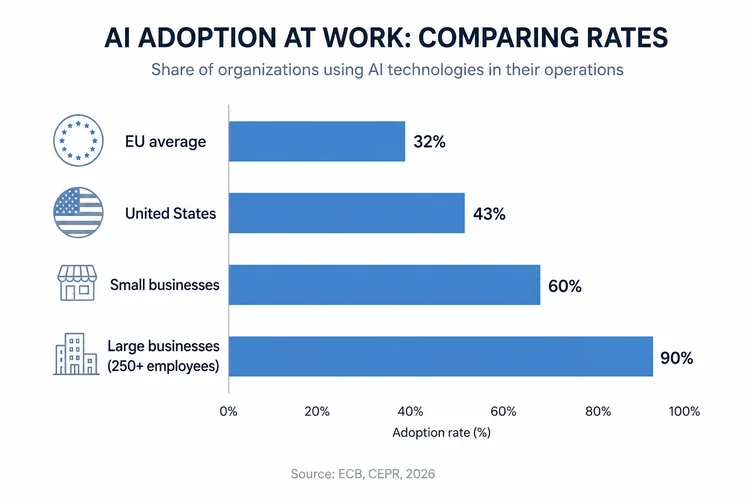
At the firm level, a European Central Bank survey of 5,000 companies found that two-thirds reported employees using AI, though usage varies sharply by company size: almost 90% of businesses with 250 or more employees use AI, compared with 60% of businesses with fewer than ten employees. Research comparing the EU and US, published via CEPR and the St. Louis Fed in 2026, found that 43% of US workers reported using generative AI at work in early 2026, compared with an EU average of 32%, with adoption ranging from 26% in Italy to 36% in the UK among the countries surveyed.
Importantly, a European Investment Bank study of more than 12,000 firms found that AI adoption increased labour productivity by around 4% on average in the EU, with no evidence of reduced employment in the short run. The productivity gains were concentrated in medium and large firms with the capacity to invest in complementary training and data infrastructure.
Which Jobs Are Being Transformed?
Rather than eliminating entire occupations outright, AI is most visibly changing the composition of tasks within jobs. Research using EU Labour Force Survey data found that exposure to AI is highest in occupations dominated by cognitive, non-routine analytical tasks, and lowest in manual, hands-on roles. Administrative, clerical, and basic content-generation tasks are among the most exposed, since generative tools can now draft text, summarise documents, and handle routine data entry.
Entry-level and graduate roles appear to be feeling this most acutely. A 2026 Handshake survey of European students and employers found that more than half of employers expect AI to change the skills required for entry-level roles and to raise the importance of communication skills specifically. European graduates report growing career pessimism, with AI cited as one contributing factor alongside broader competition for roles, though economic conditions and hiring caution are also significant drivers, making it difficult to isolate AI's effect precisely.
Youth unemployment data adds useful context. Eurostat figures from mid-2026 put euro area youth unemployment at around 14.8% and EU-27 youth unemployment at around 15.5%, with strong variation between countries, from roughly 7.5% in Germany to over 25% in parts of Southern Europe. These gaps reflect differences in vocational training systems and labour market structures as much as AI exposure specifically.
The Rise of AI-Related Roles
Alongside disruption, AI is generating new categories of work. Globally, the World Economic Forum's Future of Jobs Report 2025, drawing on more than 1,000 employers across 55 economies, projects 170 million new roles created and 92 million displaced by 2030, a net gain of 78 million jobs worldwide. AI and machine learning specialist roles are among the fastest-growing occupations identified in that report.
In the European context, demand is emerging not just for AI engineers and data scientists but for roles that sit between technical teams and business functions: AI tool rollout coordinators, prompt and workflow designers, data governance specialists, and staff who oversee AI-assisted decision-making in regulated sectors like finance and healthcare. Cybersecurity remains a persistent area of unmet demand, with national agencies across Europe reporting thousands of unfilled positions as AI adoption expands the attack surface organisations need to defend.
Which Technical Skills Are Becoming More Valuable?
According to the World Economic Forum's global survey data, AI and big data top the list of fastest-growing skills demanded by employers, followed closely by networks and cybersecurity, and general technological literacy. These are global figures, but they align with what European labour-market researchers, including Cedefop, have found in their own AI skills surveys of EU workers: a widening gap between the AI-related skills employers want and the skills the current workforce holds.
Practically, this does not mean every worker needs to become a machine learning engineer. For most professionals, the more relevant technical skills include being able to work effectively alongside AI tools, understanding their limitations, and knowing how to evaluate AI-generated output critically rather than accepting it at face value.
Why Data Skills Matter
Data literacy sits underneath most of the technical shifts described above. Whether a role involves marketing, finance, operations, or customer service, employers increasingly expect staff to interpret data, spot errors or bias in AI-generated analysis, and make decisions informed by evidence rather than intuition alone.
This is one reason why analytical thinking consistently ranks among the World Economic Forum's top skills for 2025 to 2030, alongside AI and big data specifically. The two are linked: as AI tools handle more of the mechanical work of processing data, the human value shifts toward judgement about what the data means and how it should inform action.
Why Human Skills Still Matter
Despite the technical shift, the evidence does not support a narrative where human skills become less important. If anything, several studies point the opposite way. The World Economic Forum's research consistently shows creative thinking, resilience, flexibility and agility, and curiosity and lifelong learning rising in importance alongside technical skills, not being displaced by them.
This makes intuitive sense. As AI takes on more routine analytical and drafting work, the tasks that remain distinctly human, such as complex judgement, stakeholder communication, ethical reasoning, and leadership, become relatively more valuable. One European hiring perspective, shared by a software firm hiring junior developers for EU clients, put it plainly: prompt engineering is comparatively simple to teach, but the ability to communicate clearly, take feedback, and adapt within a team is what actually predicts whether a new hire succeeds.
What Employers Are Looking For in 2026
European employers appear less focused on specific AI certifications and more focused on how candidates think and adapt. Employer surveys point to a few consistent themes: a demonstrated ability to use AI tools responsibly and critically, strong written and verbal communication, evidence of practical output such as portfolios or projects rather than credentials alone, and a track record of learning quickly in unfamiliar situations.
At the same time, some hiring managers report specific concerns about newer entrants to the workforce, including gaps in professional communication and basic document literacy. This suggests that foundational workplace skills, not just AI fluency, remain a genuine differentiator, particularly for graduates competing in a tighter entry-level market shaped by both AI adoption and broader economic caution.
How Professionals Can Prepare
For most professionals, the most effective preparation is not necessarily a full career pivot into a technical AI role. It is building fluency with the AI tools relevant to your own field, strengthening the human-centred skills that remain in demand, and staying current as employer expectations shift.
Practical starting points include: learning to use generative AI tools critically within your current role rather than avoiding them, building demonstrable project or portfolio evidence of your work rather than relying solely on credentials, developing data literacy even outside formal technical roles, and treating communication and adaptability as core professional skills rather than soft extras.
What Career Changers Should Prioritise
For people considering a move into a more technical or AI-adjacent role, the evidence points toward a few areas of genuine, sustained demand across Europe: data-related roles, cybersecurity, and positions that combine technical understanding with domain expertise in a specific industry, such as finance, healthcare, or the public sector. Broad, generic "AI skills" claims matter less to employers than specific, demonstrable ability to apply AI tools to a real business problem.
Career changers should also weigh realistic timelines. Entry-level tech hiring in parts of Europe has tightened, so building a portfolio, gaining practical project experience, and networking within a target sector are likely to matter as much as any single qualification.
Conclusion
The evidence from European institutions paints a more nuanced picture than either extreme of the AI-and-jobs debate. AI adoption is real and growing across Europe, though still behind the United States, and it is changing the composition of many jobs rather than eliminating employment outright. Productivity gains are real for firms that invest properly, and new categories of work are emerging alongside disrupted ones.
For professionals, the practical takeaway is not panic but adaptation. The people best positioned for 2026 and beyond are those who combine genuine comfort with AI tools and the human skills that no current AI system can fully replace: judgement, communication, and adaptability.
Sources
- Generative AI at Work: From Exposure to Adoption in European Workplaces, Eurofound, based on the 2024 European Working Conditions Survey
- The AI-adoption divide: who benefits, who doesn't, and what it means for workers, European Commission
- Artificial Intelligence: friend or foe for hiring in Europe today?, European Central Bank
- Differences in AI adoption in Europe and the US, CEPR
- How AI is affecting productivity and jobs in Europe, CEPR
- AI adoption, productivity and employment: Evidence from European firms, European Investment Bank
- The Future of Jobs Report 2025, World Economic Forum
- Eurostat, EU Labour Force Survey and youth unemployment data (2026)
- Europe talent outlook: 2026 graduates in the AI economy, Handshake

Learn technical skills online with Code Labs Academy
Join our supportive community, unlock your potential, and embark on a rewarding career path.
Apply Now