
Prompting, Guardrails, and Redaction: Safe LLM Workflows for Clinical Psychologists
Updated on January 25, 2026 18 minutes read
Large language models (LLMs) can be genuinely useful for clinical psychology work, especially for drafting progress notes, summarizing structured intake data, and rewriting clinician-written text into clearer language. The catch is that the most useful text is often the most sensitive: it includes patient narratives, family context, and uniquely identifying life details.
The technical problem is not that LLMs “aren’t smart enough.” The problem is that they are probabilistic generators that will confidently fill in gaps, mirror identifiers, and sometimes produce output that sounds clinically authoritative even when it is unsupported by the input.
In a mental health workflow, those failures are not cosmetic. A hallucinated symptom can become a documentation error; an echoed identifier can become a privacy incident; an overconfident tone can create automation bias and distort clinical judgment.
This article is for clinical psychologists, clinical ops leads, and engineers building mental health tooling who want a defensible, production-friendly approach. It focuses on safe drafting and summarization patterns, not on replacing clinical decision-making.
After reading, you’ll be able to design prompts that reliably produce structured drafts without inviting diagnosis or invention. You’ll be able to implement practical redaction and leakage detection that blocks unsafe requests before they ever reach an LLM.
You’ll also be able to add guardrails beyond prompting schema validation and policy checks, so safety is enforced deterministically. Finally, you’ll understand how to monitor, audit, and govern these workflows as real systems.
Note: This is a technical guide, not legal advice. If you operate under HIPAA, GDPR, or other health/privacy regimes, you should work with your organization’s compliance and legal teams.
Background and prerequisites for safe clinical LLM workflows
What you should already know
You should be comfortable reading Python and working with basic data structures and text processing. Familiarity with introductory machine learning concepts (train/test splits, precision,n, and recall) will help when we build a lightweight leakage detector.
On the domain side, you don’t need to memorize regulations, but you do need strong instincts about confidentiality and documentation boundaries. In mental health, notes are not just “tex;t” they are clinical artifacts that propagate into care, billing, supervision, and sometimes legal discovery.
Clinical context: why psychology workflows are uniquely sensitive
Clinical psychology documentation often contains identifying narrative detail even when obvious identifiers are removed. Someone can be re-identified by a rare job, a distinctive event, or a specific combination of dates and places, especially in small communities.
It also matters what kind of notes you are handling. Under HIPAA, “psychotherapy notes” have a specific definition and receive special protections compared with most other types of PHI, which should influence your data handling defaults.
A safe design assumption is that raw psychotherapy notes should not be sent to an LLM at all unless your governance posture explicitly permits it, controls are strong, and the use case is clearly justified. For many teams, the better path is to draft structured progress notes from minimized, clinician-entered summaries.
Tech context: why prompting alone is not a safety strategy
At a high level, an LLM generates output by modeling a conditional distribution like , where is your prompt and is the generated text. Prompting changes , which changes the distribution, but it does not create a hard guarantee.
Safe LLM applications are better understood as pipelines than as single model calls. You typically need (1) data minimization and redaction before the call, (2) structured generation constraints during the call, and (3) validation and policy enforcement after the call.
Security communities now treat LLM apps as a new attack surface. Risks like prompt injection and insecure output handling are especially relevant in patient-facing channels and clinical documentation pipelines.
Core theory: prompting, guardrails, and redaction as “controls on an information flow.”
A simple mental model: your system is a controlled transformation
A safe clinical workflow treats an LLM as one component inside a controlled transformation:
Here, is raw clinical text, is minimized/redacted text, is a structured prompt, is the model’s raw output, and is what your system allows into clinical workflows.
This framing matters because it makes “safety” a property of the system, not the model. If you rely on the model to self-police, you are betting your privacy posture on probabilistic behavior.
Prompting as interface design, not “clever wording.”
In clinical psychology, most LLM use cases are not creative writing tasks. They are closer to “draft a structured clinical artifact from a constrained source,” such as a progress note section or a patient-friendly summary.
The safest prompts are explicit and narrow. They define the role, the allowed input, and what the model must never do, such as inventing facts, diagnosing, or providing crisis instructions.
Structured output formats reduce risk because they create a contract you can validate. If you request JSON with fixed fields, you can reject malformed outputs and enforce length limits before text ever reaches an EHR or client-facing channel.
Guardrails: constraints you can test, not promises you hope the model keeps
Guardrails come in layers that reinforce one another.
The first layer is prompt constraints: “use only provided text,” “do not add new facts,” and “flag uncertainty.” This reduces failure rates but does not eliminate them.
The second layer is generation constraints, when your stack supports them. Examples include JSON mode, schema-constrained decoding, or tool-free generation that forbids arbitrary function calls.
The third layer is deterministic enforcement: schema validation, regex/NER leakage checks, and policy rules that decide “allow,” “block,” or “route to human.” This is where you mitigate insecure output handling by treating LLM output as untrusted input.
Redaction and de-identification: reducing exposure before the model call
Redaction removes or masks sensitive strings. De-identification is broader: it aims to reduce the likelihood that an individual can be identified.
Under HIPAA, HHS discusses two methods for de-identification: “Safe Harbor” and “Expert Determination.” Operationally, many teams begin with Safe Harbor-style removal of direct identifiers and then evaluate stronger approaches when needed.
A useful way to think about redaction is as an optimization problem with a trade-off between utility and risk:
Here, represents how useful the redacted text is for drafting a clinical artifact, while represents an acceptable residual risk of disclosure. In mental health workflows, should usually be small, and the pipeline should remain usable even when the LLM is unavailable.
Hands-on implementation in Python: redaction, leakage detection, and rule-based post-processing
We’ll build a minimal but realistic pipeline around therapy-style notes. The goal is not perfect anonymization, but a defensible system that (1) redacts obvious identifiers, (2) detects likely leaks, and (3) enforces structure and safety rules after generation.
Step 1: Create a toy dataset that resembles clinical text
In practice, you would load notes from an EHR export, a practice system, or a secure database. Here we simulate a similar shape: note IDs and note text.
import re
import json
import pandas as pd

notes = pd.DataFrame(
    {
        "note_id": [101, 102, 103, 104],
        "note_text": [
            # Contains multiple identifiers
            "Client: Alex Rivera. DOB: 1991-04-12. Phone: (555) 013-4455. "
            "Discussed panic symptoms after workplace incident. Follow-up next Tuesday."

            # Mostly de-identified narrative but still sensitive
            "Client reports recurring intrusive thoughts and avoidance. "
            "Explored CBT model and planned graded exposure homework."
            # Email + address-like pattern
            "Contact email: jordan.smith@example.com. Address: 123 Example St, Springfield. "
            "Session focused on sleep hygiene and rumination."
            # A message-like note that should be routed, not “handled by the model.”
 .           "Portal message: 'I can't stop thinking about hurting myself.' "
            "Client asks what to do tonight."
        ],
        # Label whether the raw note contains obvious identifiers we want to redact.
        # In practice, labels come from annotation + policy definitions.
        "has_obvious_identifiers": [1, 0, 1, 0],
    }
)
Even in this small sample, two risk types appear quickly. Notes 101 and 103 contain direct identifiers like dates, phones, and emails. Note 104 contains crisis-relevant content. A safe system treats that as a routing and escalation problem, not a text-generation problem.
Step 2: Implement a first-pass redaction function
This redactor focuses on common identifier patterns. It is not complete by itself, but it is deterministic, testable, and easy to run locally.
PHONE_RE = re.compile(r"(\+?\d{1,2}\s*)?(\(?\d{3}\)?[\s.-]?)\d{3}[\s.-]?\d{4}")
EMAIL_RE = re.compile(r"[A-Za-z0-9._%+-]+@[A-Za-z0-9.-]+\.[A-Za-z]{2,}")
DATE_RE  = re.compile(r"\b(\d{4}-\d{2}-\d{2})\b")  # ISO dates (common in exports)
URL_RE   = re.compile(r"https?://\S+")
SSN_RE   = re.compile(r"\b\d{3}-\d{2}-\d{4}\b")

# Simple address heuristic (imperfect, but illustrates the approach)
ADDRESS_RE = re.compile(
    r"\b\d{1,5}\s+\w+\s+(St|Street|Ave|Avenue|Rd|Road|Blvd|Lane|Ln)\b",
    re.IGNORECASE
)

def redact_text(text: str) -> str:
    text = EMAIL_RE.sub("[EMAIL]", text)
    text = PHONE_RE.sub("[PHONE]", text)
    text = SSN_RE.sub("[SSN]", text)
    text = URL_RE.sub("[URL]", text)
    text = DATE_RE.sub("[DATE]", text)
    text = ADDRESS_RE.sub("[ADDRESS]", text)
    return text
This kind of redaction reduces the probability of direct identifier leakage. It also creates a clear place to add stronger redaction later, such as a named-entity recognition model.
In clinical psychology, the safest default is that redaction runs before any LLM call, ideally within your secure boundary. That way y, you minimize data exposure by design.
Step 3: Apply redaction and inspect the transformed text
notes["redacted_text"] = notes["note_text"].apply(redact_text)

for row in notes[["note_id", "note_text", "redacted_text"]].to_dict("records"):
    print(f"\n--- NOTE {row['note_id']} ---")
    print("RAW:     ", row["note_text"])
    print("REDACTED:", row["redacted_text"])
In production, you typically store raw notes and redacted artifacts separately. You also avoid logging raw clinical text, because logs are a common source of accidental disclosure. If psychotherapy notes are in scope, separation becomes even more important.
Your architecture should make it difficult to “accidentally paste raw psychotherapy notes into an LLM input box.”
Step 4: Build a “pre-flight” leakage detector (simple ML, high recall)
Regex redaction catches patterns you know. But clinical notes contain messy identifiers and semi-identifiers that slip through inconsistent formatting.
A practical pattern is to add a classifier that predicts whether the text likely still contains identifiers. You tune it for recall, because false negatives are more damaging than false positives in privacy-sensitive workflows.
Below is a lightweight approach: character n-grams with logistic regression. Character features often detect email/phone residues even when formatting changes.
from sklearn.model_selection import train_test_split
from sklearn.pipeline import Pipeline
from sklearn.feature_extraction.text import TfidfVectorizer
from sklearn.linear_model import LogisticRegression
from sklearn.metrics import classification_report

X = notes["redacted_text"]
y = notes["has_obvious_identifiers"]

X_train, X_test, y_train, y_test = train_test_split(
    X, y, test_size=0.5, random_state=42, stratify=y
)

leakage_model = Pipeline(
    steps=[
        ("tfidf", TfidfVectorizer(analyzer="char_wb", ngram_range=(3, 5))),
        ("clf", LogisticRegression(max_iter=200))
    ]
)

leakage_model.fit(X_train, y_train)
pred = leakage_model.predict(X_test)

print(classification_report(y_test, pred, digits=3))
With real data, this model becomes more useful as you label more examples. Even a modest classifier can enforce policy: if a note is “likely still identifying,” you block the LLM call and route to manual review.
This is the core safety mindset. You do not need the model to be perfect; you need the workflow to fail safely and predictably.
Step 5: Create a prompt template designed for clinical draft artifacts
Now we define a prompt that limits the model to the provided text, forbids invention, and forces a structured output that can be validated.
SYSTEM_PROMPT = """
You are assisting a licensed clinical psychologist with documentation.
You must follow these rules:

1) Use ONLY the provided note text. Do not invent facts, history, diagnoses, or risk conclusions.
2) Do not include identifying details. If identifiers appear, replace them with [REDACTED].
3) If the note suggests imminent risk or crisis, do NOT give self-help instructions.
   Instead, set route_to_human=true and provide a short rationale.
4) Output MUST be valid JSON matching the required schema.
"""

def build_progress_note_prompt(redacted_note: str) -> str:
    schema_description = """
Return JSON with keys:
- "summary": 3-5 sentences summarizing the clinical content from the note.
- "interventions": short description of interventions discussed (if any).
- "homework": short description of client tasks (if any).
- "open_questions": uncertainties or missing details that a clinician should fill in.
- "route_to_human": boolean
- "routing_reason": short string, empty if route_to_human is false
"""
    return (
        SYSTEM_PROMPT.strip()
        + "\n\nREQUIRED_SCHEMA:\n"
        + schema_description.strip()
        + "\n\nNOTE_TEXT:\n"
        + redacted_note.strip()
    )
The "route_to_human" field is a design decision, not a model feature. It gives you a clean way to route risky content away from automation and into a clinician-controlled process.
In a clinical setting, crisis protocols are organizational and jurisdiction-specific. Your LLM should not improvise them; your system should route to humans and display your approved protocol.
Step 6: Post-processing guardrails: validate structure and block unsafe content
Assume you call an LLM and get back a text response. Before you store it or show it in a clinical UI, validate and enforce policy.
def is_potential_identifier_leak(text: str) -> bool:
    patterns = [EMAIL_RE, PHONE_RE, SSN_RE, DATE_RE, ADDRESS_RE, URL_RE]
    return any(p.search(text) for p in patterns)

def validate_json_schema(obj: dict) -> None:
    required_keys = [
        "summary", "interventions", "homework",
        "open_questions", "route_to_human", "routing_reason"
    ]
    for k in required_keys:
        if k not in obj:
            raise ValueError(f"Missing key: {k}")

    if not isinstance(obj["route_to_human"], bool):
        raise ValueError("route_to_human must be boolean")

    # Bound the output to reduce accidental leakage and overreach.
    if len(obj["summary"]) > 1200:
        raise ValueError("summary too long")

def postprocess_llm_output(raw_output: str) -> dict:
    obj = json.loads(raw_output)

    validate_json_schema(obj)

    # Guardrail: block if the model echoed or regenerated identifiers
    joined = " ".join(str(v) for v in obj.values())
    if is_potential_identifier_leak(joined):
        raise ValueError("Potential identifier leak detected in output")

    return obj
This approach addresses insecure output handling directly. You treat model output as untrusted input and validate it before it can affect downstream systems.
Over time, you can expand post-processing into a policy engine. For example, you can block diagnostic labels unless they were explicitly present in structured clinician input.
Step 7: Orchestrate the pipeline (with an LLM call stub)
Below is an orchestration function that shows the control flow. In production, the LLM call would use your chosen provider, but the safety logic remains the same.
def generate_clinical_draft(note_text: str) -> dict:
    redacted = redact_text(note_text)

    # Pre-flight leakage detection: block if likely identifiers remain
    leak_pred = leakage_model.predict([redacted])[0]
    if leak_pred == 1:
        return {
            "route_to_human": True,
            "routing_reason": "Pre-flight check suggests remaining identifiers; manual review required.",
            "summary": "",
            "interventions": "",
            "homework": "",
            "open_questions": "Confirm identifiers removed before any LLM use."
        }

    prompt = build_progress_note_prompt(redacted)

    # PSEUDOCODE: call your LLM provider here.
    # raw_output = llm_client.generate(prompt=prompt, temperature=0.2)
    raw_output = json.dumps({
        "summary": "Client discussed anxiety symptoms related to a recent stressor. "
                   "Explored cognitive and behavioral patterns described in the note.
        "interventions": "Reviewed CBT framing and coping strategies mentioned in the note."
        "homework": "Follow-up tasks were suggested if present in the note; confirm specifics."
        "open_questions": "Confirm details of frequency, intensity, and functional impact.",
        "route_to_human": False,
        "routing_reason": ""
    })

    return postprocess_llm_output(raw_output)
Notice how many safe exit points exist. The system can block before the LLM call, and it can block after generation if the output violates policy or structure.
This is the difference between “prompting” and “operating a safe workflow.” Your safety posture comes from enforcement layers, not from clever instructions.
Systems and production architecture for clinical settings
Data flow: minimize, segment, and make the “safe path” the default
A robust architecture separates raw notes from “LLM-ready artifacts.” Raw psychotherapy notes, transcripts, or audio-derived text should live in a higher-restriction store with tightly scoped access.
The LLM pipeline should receive only the minimum input required for the specific task. If the task is “draft a 4-sentence progress note summary,” the input should be a constrained excerpt or a clinician-prepared snippet, not a full session narrative.
This is a practical translation of data minimization. It also makes governance simpler: you can document exactly what types of text are eligible for LLM use.
Batch vs. interactive workflows: different risk, different controls
Batch use cases include retrospective QI summaries and supervision prep. These can run asynchronously with stronger review gates and more expensive redaction pipelines.
Interactive use cases include “draft this note section now” during documentation. These need low latency, but they also create a temptation to paste raw notes into a chat box.
A safe compromise is to make interactive tools structured by design. Replace free-text chat with a form that captures “Session themes,” “Interventions,” and “Plan,” and run redaction field-by-field.
Infrastructure and MLOps: treat LLM calls like privileged operations

From a systems perspective, the LLM call is a privileged operation because it can transmit sensitive data outside your boundary. That implies strict secret management, network egress control, and a clear vendor posture.
If you operate under HIPAA constraints, you also need to evaluate how the vendor stores, retains, or uses submitted data, and whether business associate requirements apply to your context.
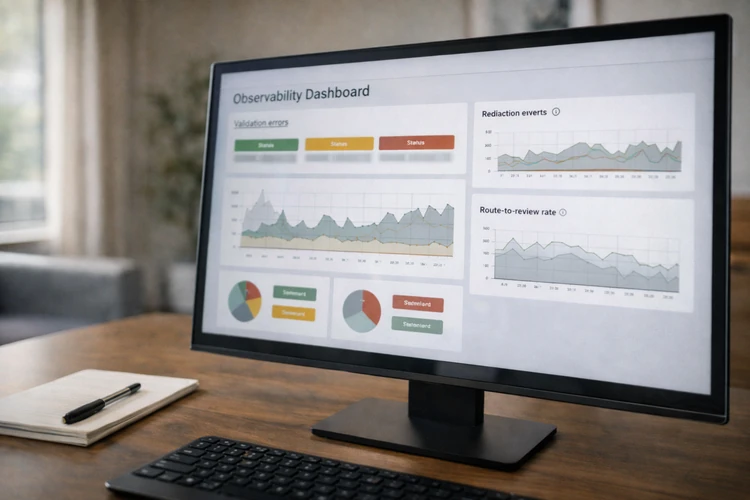
Monitoring should include safety telemetry, not just uptime. Track schema failure rates, leak detection blocks, routing triggers, and changes in token usage that may indicate prompt drift.
Cost and performance trade-offs: small models, local models, and hybrid routing
For redaction and leakage detection, you rarely need a large model. Rules plus a small classifier often provide strong value with low cost and good interpretability.
For generations, you can use hybrid routing. Lower-risk tasks can use smaller models or stricter settings, while higher-risk tasks require stronger review gates or skip generation entirely.
In mental health, interpretability and auditability frequently matter more than linguistic polish. A slightly awkward but faithful draft is better than a fluent hallucination.
Risk, ethics, safety, and governance in mental health LLM applications
Privacy and confidentiality risks extend beyond obvious identifiers
Even when you remove names, phones, and addresses, narrative detail can still identify people. This is especially true for rare conditions, distinctive roles, or unusual events.
HIPAA’s de-identification methods are a reminder that privacy risk is contextual. Safe Harbor focuses on removing specific identifiers, while Expert Determination acknowledges that residual risk can persist and may require expert analysis.
If you operate under GDPR, health data is generally treated as special category data and faces stricter processing conditions. That should push you toward strong minimization, limited purpose, and defensible access control.

Clinical safety risks: hallucinations become documentation artifacts
In clinical psychology, an LLM can introduce a “diagnostic tone” even when you did not request a diagnosis. It may add severity, indicate functional impairment, or imply risk assessments that are not supported by the input.
This matters because notes propagate. They influence continuity of care, insurance narratives, and client trust, even if the initial output was “just a draft.”
Mitigation is both technical and workflow-based. You constrain the model, validate outputs, and require the clinician's sign-off before anything becomes part of the clinical record.
Prompt injection and adversarial inputs in patient-facing channels
If your tool processes patient portal messages, assume adversarial inputs will occur. Some will be deliberate, and some will be accidental, but either way, your system must treat user text as untrusted.
The practical mitigations are the separation of system instructions from user content, denial of hidden tool access, and strict validation of outputs before they drive actions.
You also avoid letting the model directly send messages to clients without human review.
Governance: adopt an AI risk framework that fits clinical reality
The NIST AI Risk Management Framework (AI RMF) offers a practical structure for mapping risks to controls and for documenting ongoing monitoring. It helps teams move from “we think it’s safe” to “we can measure and manage safety over time.”
Privacy risk frameworks are also relevant because mental health data is among the most sensitive. Combining an AI risk framework with a privacy framework encourages explicit ownership, escalation policies, and audit readiness.
When stakes include patient safety, the right question is not “is the model smart,” but “is the system controllable, auditable, and resilient when it fails.”
Case study scenario: drafting a progress note safely from session themes
Imagine a clinic that wants to reduce documentation burden. Clinicians want an assistant who drafts a progress note summary from therapist-entered bullet themes, not from raw psychotherapy notes.
The workflow starts with a structured capture form right after the session. The clinician fills in “presenting concerns,” “interventions used,” “client response,” and “plan,” each as short text.
Before anything reaches an LLM, the system runs redaction and the leakage detector. If the detector flags likely identifiers, it blocks generation and asks the clinician to rewrite the snippet in a de-identified way.
The prompt is narrowly defined: “Convert these clinician-provided themes into a neutral progress note draft with no new facts.” The output is JSON with bounded length and an “open questions” field that forces the model to surface uncertainty.
Crisis content is treated as a routing event. If the input suggests imminent risk, the system sets route_to_human=true, blocks the generation of instructions, and follows the clinic’s human-controlled escalation protocol.
The result is not “AI replaces documentation.” The result is a drafting assistant that helps with structure and phrasing while keeping clinical responsibility and privacy controls firmly in the clinician’s hands.
Skills mapping and learning path for bootcamp-style learners
If you’re learning this as a career-switcher, the core skill is not “prompt engineering.” The core skill is secure systems design under real-world constraints, where privacy, safety, and auditability shape every technical choice.
You build Python skills by handling clinical-style text, writing deterministic redaction functions, and composing a pipeline that is testable end-to-end. You also learn to treat logging as a potential risk surface, not a default convenience.
You build ML skills by training a simple classifier for routing and leakage detection, interpreting precision/recall trade-offs, and choosing thresholds where false negatives are unacceptable. You learn that evaluation metrics are not academic; they encode domain priorities and safety assumptions.
You build systems skills by thinking in architectures: service boundaries, versioned prompts, audit trails, and policy-as-code guardrails. You learn to treat LLM output as untrusted input and enforce contracts before anything touches production workflows.
You build domain literacy by understanding why psychotherapy notes are distinct, why documentation propagates harm, and why crisis-like content must route to humans rather than become a generation task.
A strong next step is to add an annotation workflow for redaction misses so your leakage detector improves over time. Another practical step is to implement formal JSON Schema validation and run prompt-injection red-team tests against your pipeline so your controls hold up under adversarial or messy real-world inputs.
If you want a structured path to develop these skills with guidance and portfolio outcomes, explore Code Labs Academy’s programs and learning resources and use them to plan a project-based progression from Python foundations to secure AI workflows.
Conclusion
Prompting is necessary but insufficient; safe clinical use requires an end-to-end pipeline with redaction and deterministic enforcement so the system can fail safely and predictably.
Redaction reduces exposure, but you still need leakage detection and post-generation validation to prevent accidental disclosure and to stop unsupported claims from entering documentation.
Guardrails should be testable controls: schema validation, policy checks, and routing rules for crisis content. In high-stakes mental health workflows, “please be safe” is not a control enforcement.
Governance matters because mental health work is high-stakes; risk frameworks help teams operationalize safety monitoring, define ownership, and create escalation paths when the system encounters ambiguous or risky situations.
If you want a concrete project, build a “clinical draft assistant” that only accepts clinician-entered themes, redacts identifiers, produces structured JSON, and blocks anything that fails validation. You’ll learn more from that one end-to-end tool than from isolated prompt experiments.